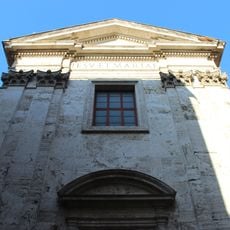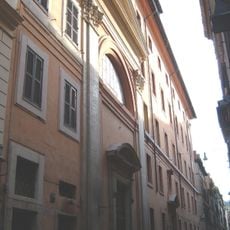
Studio Canova, Neoclassical palazzo in Campo Marzio district, Rome, Italy.
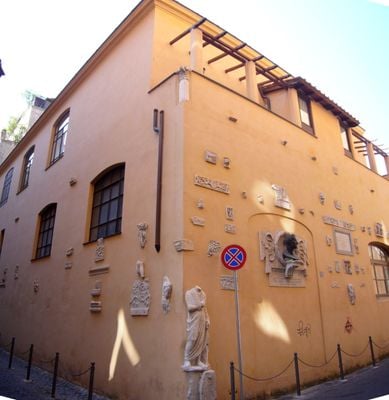
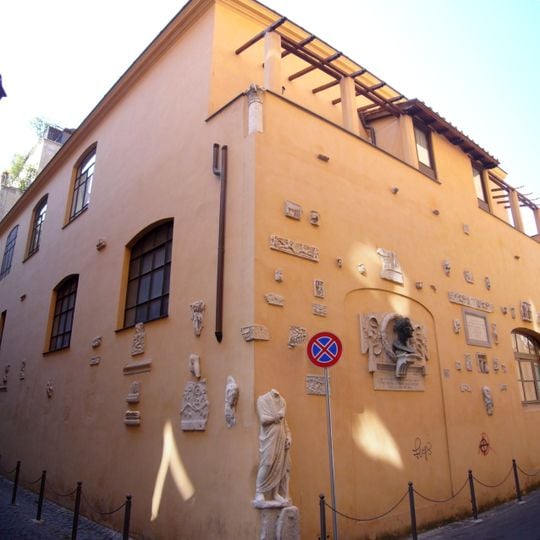
Studio Canova is a tall, flat-walled building corner in ochre plaster, rising to a shallow tiled roof with exposed wooden beams above a loggia of square columns near the top. The left face has three arched windows with dark glazing on the lower level and two smaller rectangular windows higher up. The right face is studded with small stone fragments and reliefs set into the plaster, a niche holding a bust, and a standing draped statue at the base.
The artist purchased several small houses in this area in 1803 and transformed them into his workshop. The building was later recognized as a monument of national importance and placed under heritage protection.
The building is still known as Studio Canova, after the sculptor who ran his workshop here from 1803. A stone plaque placed on the facade facing today's Via Canova in 1822 records that Canova left the property and his workshop equipment to his collaborator Antonio D'Este and D'Este's son Alessandro. Ancient pieces from Canova's study collection remain set into the outer walls.
The building stands at Via delle Colonnette 26A-27 in the Campo Marzio district, near the former Porto di Ripetta. It is privately owned and since 1978 has housed an art gallery, so it is not open as a museum; the facade can be viewed from the street. A plaque on the Via Canova side records the 1822 bequest.
The 1822 plaque on the facade facing today's Via Canova records that Canova left the building and its workshop equipment to the sculptor Antonio D'Este and his son Alessandro. The archaeological pieces set into the walls are the remains of the study collection Canova kept here.
The community of curious travelers
AroundUs brings together thousands of curated places, local tips, and hidden gems, enriched daily by 93,717 contributors worldwide.