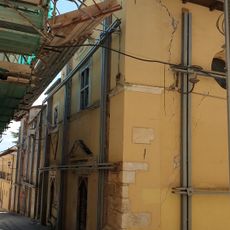
Palazzo Centi, Baroque palace in L'Aquila, Italy.
Palazzo Centi occupies an entire block in L'Aquila's Santa Giusta quarter, facing the church of the same name near Piazza del Duomo. It has four free facades, about 42 m by 36 m, with full-height Ionic pilasters at the corners. The tripartite main front has a balcony on six columns rotated 45 degrees above the portal; inside is a regular quadrangular plan around a central courtyard.
Palazzo Centi stands on a 16th-century building attributed to the Alfieri-Ossorio family, of which a 1556 date carved on a wall survives. After the 1703 L'Aquila earthquake, Gian Lorenzo Centi bought the house in 1747 and the whole complex in 1752, rebuilding it until 1772 in a late-Baroque shell around the older core. The design is attributed to Mastro Cola de Cicco, born Loreto Cicchi of Pescocostanzo. The palace was declared a national monument in 1902.
The Centi family built the palace partly to answer their exclusion from L'Aquila's patriciate, and a legend says Lorenzo Centi erected it to win the hand of a Dragonetti descendant of higher rank. It remained the family's residence for over two centuries, and from the mid-1990s it housed the presidency of the Abruzzo Region until 2009.
The palace is located in central L'Aquila and is easily accessible. Following the 2009 earthquake, it underwent restoration work that may still be ongoing, so checking current visiting conditions beforehand is recommended.
Beneath the terraced garden beside the palace lies a large cylindrical stone neviera, or snow store, among the biggest in Italy. It probably predates the palace and was likely run commercially, since snow was an important means of preserving food.
The community of curious travelers
AroundUs brings together thousands of curated places, local tips, and hidden gems, enriched daily by 94,617 contributors worldwide.