Corvaja Palace, Medieval palace in Piazza Badia, Taormina, Italy.
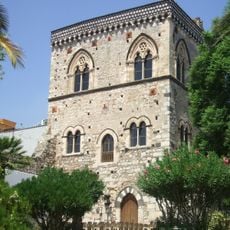
Corvaja Palace is a palace in Taormina that combines construction from several different periods into a single structure. The building features a central courtyard with Gothic arched windows, lancet windows separated by columns, and walls decorated with carved stone reliefs.
The palace stands on Roman foundations and incorporates a Norman fortress of the 12th to 14th centuries; its main body is a Norman-style tower, absorbed into the building from the late 13th century. The Salone del Maestro giustiziere was built by Juan de Termes, appointed by Frederick II. The right wing was added in the early 15th century for the Sicilian Parliament, which met here in 1410 or 1411 while Blanche of Navarre was regent. The building was expropriated after the war and restored over three years by the Neapolitan architect Armando Dillon.
The palace takes its name from the Corvaja family, one of Taormina's oldest, which owned it from 1538 to 1945. The three reliefs of the Creation, carved in Siracusa stone, stand on the landing of the small staircase leading from the courtyard to the first floor. Today the ground floor houses the tourist information office and the first floor the museum of Arts and Popular Traditions.
The building now houses a tourist office and a museum displaying collections of Sicilian culture and traditional crafts. The central courtyard is visible from the surrounding galleries, allowing visitors to view the architectural details from different angles.
The Arab tower was absorbed into the rest of the building from the end of the 13th century, so it survives as the palace's main body rather than as a free-standing structure. The Corvaja family, who gave the palace its name, owned it from 1538 until 1945.
The community of curious travelers
AroundUs brings together thousands of curated places, local tips, and hidden gems, enriched daily by 94,072 contributors worldwide.