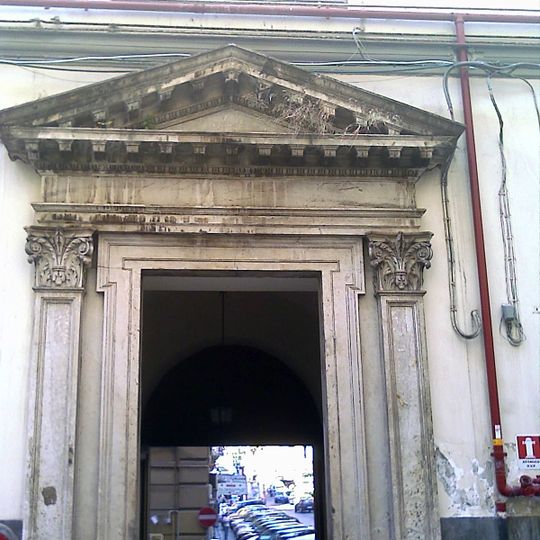
Palazzo della Zecca, Royal mint palace in Naples, Italy.
Palazzo della Zecca is a palace in Naples defined by a rusticated stone entrance facade on the outside. Its interior features a vestibule with coffered ceilings that opens into a courtyard, while a second entrance facade was added along Rettifilo avenue during the city's modernization.
The palace was built in the 13th century and later became the royal mint, where official coins of the Kingdom of Naples were struck from 1528 to 1867. Its role as a mint ended in the 19th century as the city's economic and administrative infrastructure changed.
The western wing displays a sequence of overlapping arches framing piperno stone cornices, a volcanic material typical of Naples. This stone type shapes local architecture and gives the building its distinctive appearance.
The building is accessible from multiple directions, particularly through the main entrance and the additional facade facing Rettifilo avenue. The interior layout with a vestibule and courtyard makes navigation easy when exploring the space.
The courtyard features two superimposed levels, each with its own arches and openings that create layered visual patterns. This stacked arrangement shows how medieval and early modern architectural styles were literally built on top of each other in Naples.
The community of curious travelers
AroundUs brings together thousands of curated places, local tips, and hidden gems, enriched daily by 92,118 contributors worldwide.