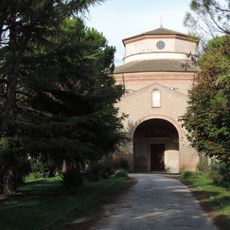
Santa Maria in Acquedotto, Romanesque church in Forlì, Italy.
Santa Maria in Acquedotto is a church built in First Romanesque style, marked by rounded arches, thick stone walls, and a facade with decorative details. The building displays the key features of this medieval architectural period in its material and forms.
The first documented mention of the pieve dates to 963, though the original church was built in the second half of the 6th century. The current building was erected in the 13th century on the remains of an earlier Byzantine church. Three Romanesque phases followed, around the year 1000, in the early 12th century and around the mid-12th century.
The name Pieve Acquedotto comes from the tradition that Trajan's aqueduct passed here, though some scholars identify the site with the ancient course of the Ronco river. The church was a pieve, a baptismal church serving the surrounding rural community, and nearby stood the unfortified village of Villa Plebis Acqueductus, documented in the late 14th century.
The pieve stands in open countryside about 4 km from Forlì's centre, near the motorway exit on the road to Ravenna, at roughly 20 m above sea level. Because the ground around it has risen over the centuries, the original floor lies 2.80 m below the present one; look for the stripped T-columns and the arch springings in the nave. The canonica to the left of the church still shows bullet holes from wartime aircraft machine-gun fire.
The floor of the church lies 2.80 metres above the original early Christian walking level, raised over centuries as the surrounding plain silted up. On the T-shaped columns of the nave, patches of plaster were stripped away to reveal the springing of arches that once carried the dividing walls.
The community of curious travelers
AroundUs brings together thousands of curated places, local tips, and hidden gems, enriched daily by 93,668 contributors worldwide.