MuSaBa, Contemporary art park museum in Mammola, Italy
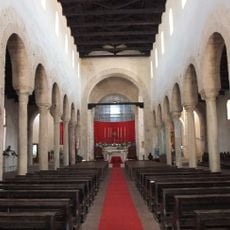
MuSaBa is a park-museum on the Santa Barbara cliff in Mammola, built around a former Basilian monastery founded in the 10th century. Its seven hectares hold olive and citrus trees, Mediterranean gardens, the deconsecrated church, and structures by Nik Spatari and Hiske Maas, including the Rosa dei Venti, which serves as ticket office and exhibition hall.
A paleochristian church with three niches stood on the Santa Barbara cliff between 300 and 450. Basilian monks founded the monastery in the 10th century, holding land across Mammola, Grotteria, Gerace and Caulonia. Carthusians rebuilt the church after an earthquake around 1000–1100; Cistercians held it from 1193 to 1514, then Carthusians returned until feudalism was abolished in 1808. Abandoned and used by farmers, it became a park-museum in 1969.
The name MuSaBa combines Mammola, Santa Barbara and the artists' names, and the site grew from Nik Spatari and Hiske Maas settling in the ruins in 1969. Their first exhibition followed in 1971, staged among the remains. Spatari worked with local students in the manner of Renaissance workshops, and mosaic workshops and competitions for students of all ages are still held here.
Access is on foot through pathways that wind across the grounds, allowing exploration of all areas. Visitors should wear comfortable shoes since the terrain is hilly and some paths are unpaved.
The church's apse is covered by Il Sogno di Giacobbe, a 14-metre-high fresco by Nik Spatari. Its figures, animals and men are cut from light wooden sheets, painted and applied as reliefs, so they seem detached from the painted background. Jacob bears Spatari's own features and stands as the artist's alter ego.
The community of curious travelers
AroundUs brings together thousands of curated places, local tips, and hidden gems, enriched daily by 93,694 contributors worldwide.