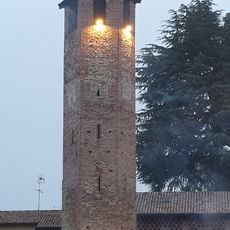
Pieve di Volpedo, Romanesque church in Volpedo, Italy
Pieve di Volpedo, dedicated to Saint Peter, is built of brick and river pebbles. Its gabled facade, with a simple pointed-arch portal and asymmetrically placed pilaster strips, reveals three naves inside; the side naves were raised in the 15th-century rebuilding. Four square pillars per row carry pointed and round arches under a trussed roof, and only the main apse remains, decorated with pilaster strips and hanging arches.
The church is first documented in a parchment of 965. In the 15th century it was rebuilt: the side naves were raised and the original apsidioles that closed them disappeared, leaving only the main apse. The late-15th-century frescoes are attributed to the workshop of the Boxilio brothers of Castelnuovo Scrivia, active also at Milan Cathedral.
The frescoes are attributed to the workshop of the Boxilio brothers of Castelnuovo Scrivia, also recorded as Baxilio or Basiglio, the leading painters of the Tortona area, active in the 15th and early 16th centuries. The apse shows a Christ Pantocrator with the four evangelists' symbols, the Virgin, Saint Michael and King David. On the pillars, ex-voto saints include Saints Cosmas and Damian by a certain Antonius, who signed a fragment in 1462.
The church stands in Volpedo, reached on foot along village streets; the facade faces the open space with the ogival portal as the entrance. The interior is on one level, with four square pillars per side dividing the three naves, so the aisles can be walked. Visit in daylight, as the apse frescoes depend on natural light.
The church is built of brick and river pebbles, not quarried stone. Its small bell gable appears in Giuseppe Pellizza da Volpedo's painting Fiumana, a work in the series that led to Il quarto stato.
The community of curious travelers
AroundUs brings together thousands of curated places, local tips, and hidden gems, enriched daily by 92,858 contributors worldwide.