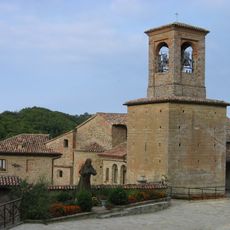
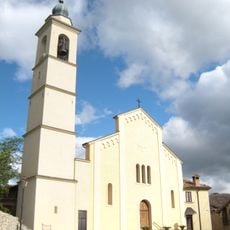
Pieve di San Zaccaria, Romanesque church in Rocca Susella, Italy.
The pieve di San Zaccaria is a Romanesque church building featuring a facade of alternating sandstone and brick bands. Its interior is defined by carved capitals and relief-decorated portals that form the distinctive architectural character.
Built probably in the first half of the 12th century by Comacine masters, the pieve is first documented in 1561. As a head pieve it governed the parishes of Sant'Eusebio, Montesegale, Sanguignano, San Giovanni di Piumesana, Groppo, Susella and Godiasco until 1700. In 1820 it was reduced to a simple parish and most of the building was later deconsecrated for agricultural use.
The name San Zaccaria refers to the church's dedication, and the building served as a Capo-Pieve, on which the parishes of Sant'Eusebio, Montesegale, Sanguignano, San Giovanni di Piumesana, Groppo, Susella and Godiasco depended until 1700. Around 1900 the Voghera painter Edoardo Cerutti painted a scene from the life of Saint Zechariah in the lunette in imitation mosaic; no decoration remains there today.
The church stands in the Ardivestra valley, in the territory of Rocca Susella, and is reached by local roads; the building is oriented, with the facade facing west. Much of the structure was deconsecrated and used for agricultural purposes, so the interior may not be visitable. The southern nave, rebuilt in the 20th century, is covered by a roof and holds a stone staircase down to a vaulted cellar.
The south aisle was rebuilt in the 20th century after the parish house was demolished; a stone staircase there leads down to a room with irregular stone vaults, probably the parish house cellar from the late 16th century. Around 1900 the painter Edoardo Cerutti of Voghera painted a scene from the life of Saint Zechariah in the lunette as a fake mosaic, now lost.
The community of curious travelers
AroundUs brings together thousands of curated places, local tips, and hidden gems, enriched daily by 93,845 contributors worldwide.