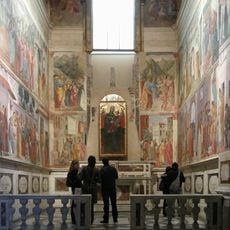
Temptation of Adam and Eve, Renaissance fresco in Brancacci Chapel, Florence, Italy.
The Temptation of Adam and Eve is a fresco by Masolino da Panicale, painted around 1424–1425, on the right side of the entrance arch of the Brancacci Chapel in Santa Maria del Carmine, Florence. It shows Adam and Eve standing as Eve is about to bite the forbidden fruit offered by a serpent with a blonde human head coiled in the tree. The work measures 260 by 88 cm.
The Brancacci Chapel frescoes lack official documentation; indirect evidence suggests they were begun in 1424, perhaps commissioned from Masolino with the younger Masaccio as assistant. In 1425 Masolino left for Hungary and Masaccio continued alone. In 1642 the first parents were covered with painted fig leaves; the scene survived the 1771 fire blackened, and the 1983–1990 restoration removed the overpaint and recovered the original colours.
The scene opens the chapel cycle, set in a tall narrow panel on the arch delimiting the chapel, opposite Masaccio's Expulsion from Eden. The two painters split the pair of scenes: Masolino's Eden is idyllic, Masaccio's expulsion terrifying, likely a deliberate contrast between humanity before and after the sin. The serpent has a blond, idealized human head.
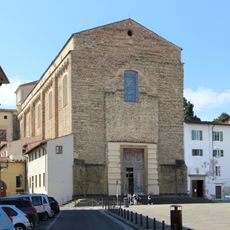
The fresco sits high on the narrow face of the arch that frames the chapel entrance, so it is seen by looking up and slightly to the right as you enter. It faces Masaccio's Expulsion on the opposite side of the same arch. The chapel is inside the church of Santa Maria del Carmine, in the Oltrarno quarter south of the Arno.
The classical pose belongs to Adam, not Eve: his figure follows an ancient canon of beauty with careful anatomical correctness. The serpent has a small head with thick, idealized blond hair. The dark background makes the two bodies stand out as if suspended in space.
The community of curious travelers
AroundUs brings together thousands of curated places, local tips, and hidden gems, enriched daily by 92,947 contributors worldwide.