Villa Rodocanacchi, 19th-century villa in Livorno, Italy
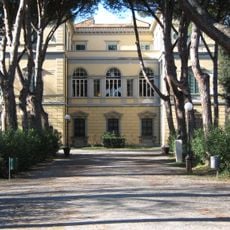
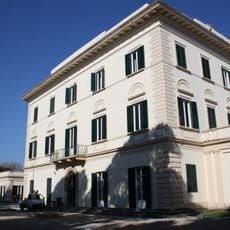
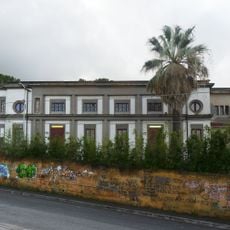
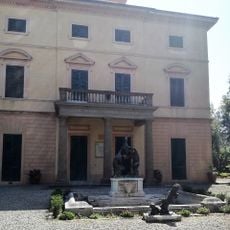
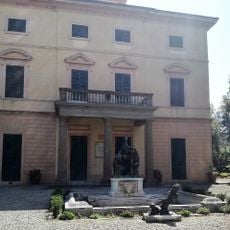
Villa Rodocanacchi stands on a hill at Monterotondo, in Livorno, within a large park. Built in 1636 as a square country residence, it had four corner projections resembling the turrets of a late-Renaissance Florentine building; these were absorbed into the main body in 1846. A drawing of about 1735 kept at the Biblioteca Labronica records the original appearance.
Count Scheriman built the villa in 1636 on land owned by the Certosa di Calci, as a square block on a hilltop. The Scherimans sold it in 1822 to Giovanni Grant, and in 1843 Emanuele Rodocanacchi bought the estate. In 1846 the four corner buttresses were absorbed into the body of the building; the exterior changes were defined by the Florentine architect Castellucci in the first decade of the 1900s.
The villa's name comes from Emanuele Rodocanacchi, the wealthy owner who bought the estate in 1843. Inside, the reception rooms held a Glorification of Music and a group of flying putti, both attributed to Giuseppe Maria Terreni and now lost. Two medallions by Bertel Thorvaldsen, Day and Night, were made during his stay at Montenero as a guest of the Schubart barons.
Villa Rodocanacchi stands on a hill in the Monterotondo district of Livorno, not on Via Calzabigi. The building itself has been closed since 2011, when the USL 6 offices moved to the city hospital on viale Alfieri. The surrounding park, reached through an agreement between the civic association Reset and the municipality, is open and under maintenance.
The terrace's mosaic floor was laid in 1886 by architect Bertini, with arabesques and figures drawn from Oriental motifs. The villa also held two medallions by Bertel Thorvaldsen, Day and Night, carved during his stay at Montenero as a guest of the Schubart barons; their present whereabouts are not recorded.
The community of curious travelers
AroundUs brings together thousands of curated places, local tips, and hidden gems, enriched daily by 94,618 contributors worldwide.