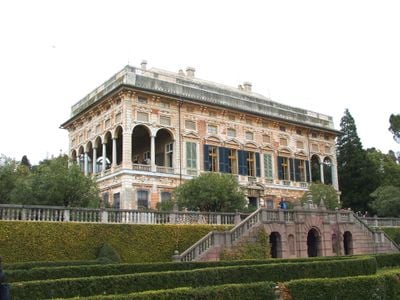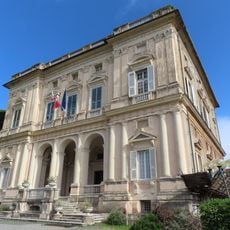
Villa Saluzzo Bombrini, 16th-century noble residence in Albaro district, Genoa, Italy.
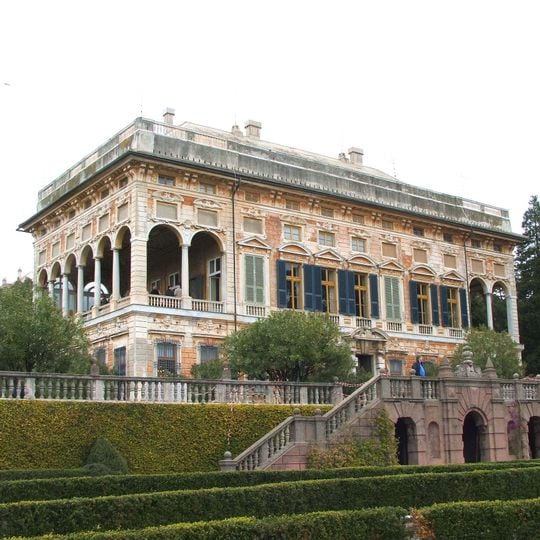
Villa Saluzzo Bombrini, called il Paradiso, stands above the other villas of Albaro at the junction of Via Albaro and Via Francesco Pozzo. Andrea Ceresola, known as il Vannone, gave it a long rectangular body rather than the cubic, pilaster-divided plan then common in Genoa, with a double corner loggia; the western one runs the full depth of the building. Its pale pink and cream facade carries two upper storeys of open arches on slender columns above a projecting cornice and flat roof, and a balustraded terrace with stone stairs leads down to a garden of dense hedges and a fountain with large bronze frogs.
The villa was designed in 1590 by architect Andrea Ceresola as a summer residence for the Saluzzo family. In 1886, ownership passed to the Bombrini family, who gave the building the second part of its current name.
The interior walls are decorated with frescoes by Giovanni Andrea Ansaldo, Lazzaro Tavarone, and Bernardo Castello, covering the atrium, the central hall, and the loggias. These paintings give a clear sense of how wealthy Genoese families chose to surround themselves with art in their private homes.
The villa is private and cannot be visited; it was opened to the public only once, for the FAI Spring Days on 24 and 25 March 2007. It stands at the junction of Via Albaro and Via Francesco Pozzo, higher than the other Albaro villas, so it is seen from the street and from the garden axis below. The entrance axis leading to the villa is slightly offset from the main portal.
Singer-songwriter Fabrizio De André lived in one of the three apartments in the villa from 1959 to 1995 and wrote many of his early songs here. This connection to one of Italy's most loved songwriters makes the building a point of interest for music fans visiting Genoa.
The community of curious travelers
AroundUs brings together thousands of curated places, local tips, and hidden gems, enriched daily by 92,892 contributors worldwide.