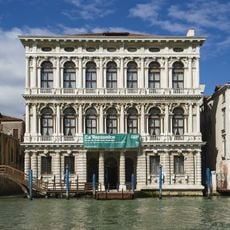
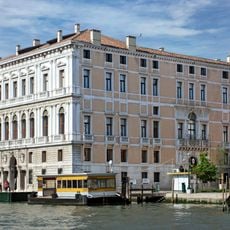
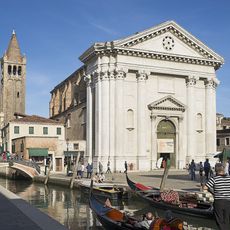
Palazzo Moro a San Barnaba, Renaissance palace in Dorsoduro district, Venice, Italy.
Palazzo Moro a San Barnaba is a Renaissance palace featuring two large four-part windows called quadrifore on its main facade facing the canal. The building includes a water portal on the Grand Canal and displays the classic architectural style of Venetian palaces from that era.
The palace was built in the early 1500s on the foundations of a Gothic structure, replacing an older medieval building. Major modifications during the 1800s transformed its appearance and shaped the form we see today.
By tradition the palace is identified as the house of Othello, the protagonist of Shakespeare's tragedy; the character is thought to derive from Cristoforo Moro, later doge, whose family life was unhappy. The name Moro, also recorded as Guoro or Barbini-Moro, comes from the Venetian family, not from a doge's title.
The building sits between two neighboring palaces and is best viewed from the water since it directly faces the Grand Canal. Visitors should approach from the canal or through nearby lanes to observe the facades and architectural details clearly.
The interior of the palace contains several courtyards, one of which features a special three-arched window arrangement called a trifora. This internal space planning is typical of Venetian palaces but often overlooked by visitors who focus on the canal side.
The community of curious travelers
AroundUs brings together thousands of curated places, local tips, and hidden gems, enriched daily by 94,670 contributors worldwide.