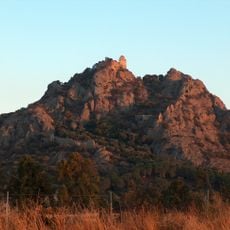
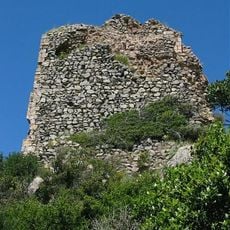
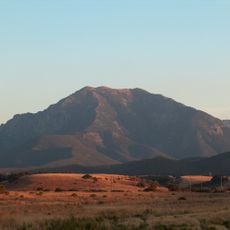
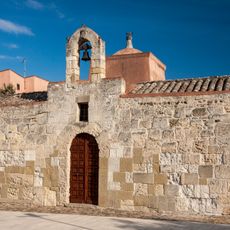
Casteddu de Fanaris, Nuragic archaeological complex in Decimoputzu, Sardinia, Italy.
Casteddu de Fanaris is a complex nuraghe from the late Bronze Age (1300–1000 BC) in Decimoputzu, on the border with Vallermosa. It has a central tower with eight towers added against it to form a bastion, surrounded by a megalithic wall with five towers fitted with loopholes. It was built mainly with granite boulders available on the spot, at 147 metres above sea level.
Casteddu de Fanaris was built in the late Bronze Age, between 1300 and 1000 BC, as a complex nuraghe: a central tower with eight towers added against it to form a bastion. It stands at 147 metres above sea level, on the border between Decimoputzu and Vallermosa, controlling the route from the Sulcis-Iglesiente to the Campidano plain.
The site shows how the Nuragic people organized their territory and watched over the land around them. The tower arrangement reveals how they thought about control and defense in their daily life, a pattern still visible in the landscape today.
The site lies at 147 metres above sea level on the border between Decimoputzu and Vallermosa, reached from the Iglesiente side. The ground is uneven among granite boulders and the megalithic wall, so sturdy shoes help. Access information is published on the Decimoputzu municipal website.
The fortress had specialized openings in its walls that let defenders watch attackers without being seen themselves. These thoughtful details show that builders thought carefully about the mechanics of defense, not just about stacking stone.
The community of curious travelers
AroundUs brings together thousands of curated places, local tips, and hidden gems, enriched daily by 93,378 contributors worldwide.