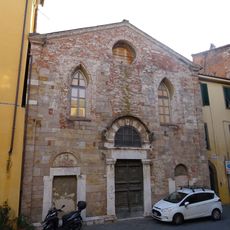
Sant'Agostino, Lucca, Catholic church in Lucca, Italy
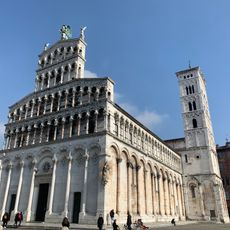
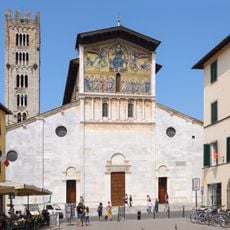
Sant'Agostino is a brick church in Lucca with a single nave and three apse chapels. Its unfinished white limestone facade is divided by pilasters. The bell tower rises on the arches of the ancient Roman theater, and the 15th-century cloister has slightly ogival arcades on octagonal brick pillars.
A church of San Salvatore in Muro, built against Lucca's Roman walls, was ceded to the Augustinians in 1324; they founded a monastery and rebuilt the church, dedicated to Sant'Agostino, between the mid-14th and late 15th centuries. In the 17th century new Counter-Reformation and Baroque altars were added. The church was deconsecrated under Napoleon and used as a military depot in the 19th century, losing most of its paintings. In 1866 the Suore Oblate dello Spirito Santo returned it to worship.
The right-hand chapel, built in 1369 by Nicolao di Simone Boccella, protects the Madonna del Sasso icon. Giacinto Gemignani frescoed its walls in 1657 with the Risen Christ pointing to the Madonna between Saints Peter, Augustine, Andrew, Nicola da Tolentino and Francis, and opposite, the Punishment of the Sacrilegious Soldier sinking through a trapdoor.
The church faces the piazza of the same name in central Lucca, a short walk from the Roman amphitheater square. The convent next door, with its 15th-century cloister of slightly ogival brick arches, has housed the Liceo musicale "Passaglia" since 2017. Look for the plaque of 1975 on the convent wall.
The bell tower rests on the arches of Lucca's Roman theater, and traces of the earlier church of San Salvatore in Mura are also visible at its base. The trapdoor linked to the legend of the Madonna del Sasso, through which a sacrilegious soldier fell toward Hell, is now sealed.
The community of curious travelers
AroundUs brings together thousands of curated places, local tips, and hidden gems, enriched daily by 94,031 contributors worldwide.