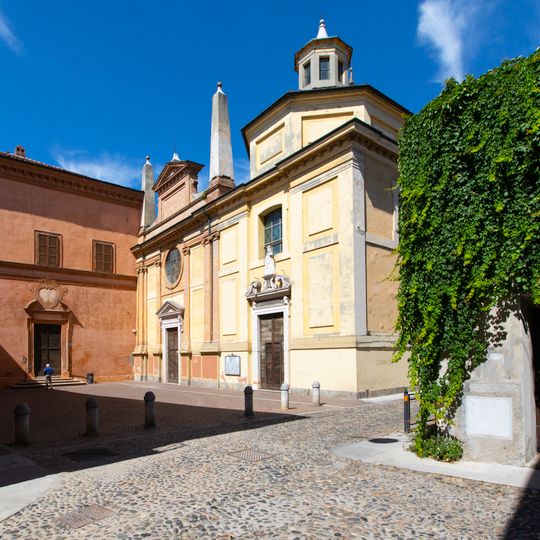
Church of Sant'Abbondio, Mannerist church building in Cremona, Italy.
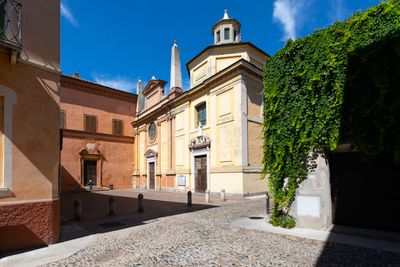
The Chiesa di Sant'Abbondio in Cremona has a sober facade by Francesco Dattaro, with two identical doorways framed by gray stone and triangular pediments, a round window on the left and a rectangular one on the right. A slender obelisk-like spire rises from the left roofline, and an octagonal cupola with a lantern tops the building. Inside, a single nave of four bays is divided by serlianas, with four side chapels per side and a rectangular presbytery.
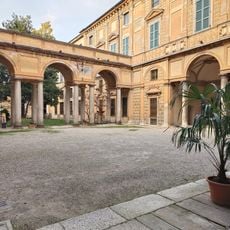
Documented since the 10th century, when Benedictine monks settled here at the wish of Archbishop Olderico, the church passed to the Humiliati in the 13th century. They enlarged the Romanesque building and added the cloister in 1511 by Bernardino Bocoli, called De Lera. After Carlo Borromeo suppressed the Humiliati, the Theatines arrived in 1577; the 1575 renovation ordered by Borromeo gave the church its present Mannerist form.
The name comes from Saint Abundius, to whom the church is dedicated. The four bays of the nave carry frescoed illusionistic openings with the theological and cardinal virtues, the Announced Virgin and the Announcing Angel, framed by caryatids, draperies, fruit festoons and putti, with prophets painted as if seated on the balustrades. The altarpiece shows the Madonna and Child with Saints Nazarius and Celsus in sumptuous 16th-century costume.
The church stands on Piazza Sant'Abbondio, with the facade facing the square. The entrance is through the main portal; the cloister and the Lauretano sanctuary are part of the same complex and can be visited together. The interior is a single nave with four bays and side chapels, so a visit follows a straightforward route from the entrance to the presbytery.
The Lauretana shrine was built in a single year, 1624, on the order of Count Giovanni Pietro Ala as a copy of the Holy House of Loreto. Its Black Madonna statue was carried here from the Cathedral in 1625. Inside, Giovanni Battista Zaist designed the 18th-century altar, which holds a wooden Holy Family by Giacomo Bertesi and a Madonna in Glory by Galeazzo Campi.
The community of curious travelers
AroundUs brings together thousands of curated places, local tips, and hidden gems, enriched daily by 94,559 contributors worldwide.