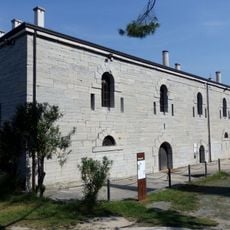
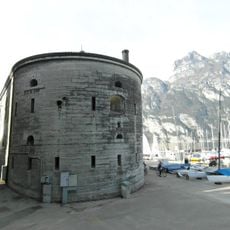
Straßensperre Ponale, Military fort near Lake Garda, Italy.
Straßensperre Ponale is a former Austro-Hungarian road barrier at the third tunnel of the Ponale road, about 150 m above sea level. Its galleries and embrasures are cut into the bare rock of the Rocchetta, extending from near lake level to roughly 80 m above the road.
The first proposal for a barrier on the Ponale road came in 1859 from August von Degenfeld-Schonburg, who planned a field cannon position. A masonry battery for four guns was built and blown up on 25 July 1866 after the Austrian defeat at Bezzecca. In April 1904 the Reichskriegsministerium ordered an infantry casemate, and from 1910 the works moved almost entirely underground.
The fort shows how soldiers lived and worked under pressure in the early 1900s, with kitchens and living areas carved deep inside the mountain. Walking through reveals the daily reality of men stationed here to guard the lake.
The visible section lies at the third tunnel of the Ponale road, about 150 m above sea level, cut into the Rocchetta rock and rising some 80 m above the road. The site extends on both sides of the road, so expect steep, uneven ground and underground passages. Sturdy shoes and a torch are useful; the road is narrow and winding.
The barrier was not built in one go: the first proposal dates from 1859, when August von Degenfeld-Schonburg suggested a field cannon position on the Ponale road. The battery erected there was blown up by Austrian troops on 25 July 1866, after the defeat at Bezzecca, and the structure visible today was only ordered in April 1904.
The community of curious travelers
AroundUs brings together thousands of curated places, local tips, and hidden gems, enriched daily by 93,389 contributors worldwide.