Santissima Annunziata, Renaissance church in Marcianise, Italy.
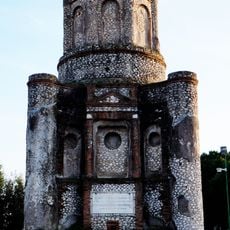
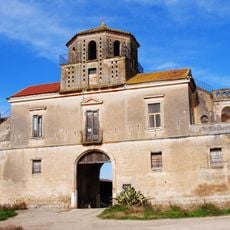
The Santissima Annunziata is a Renaissance church in Marcianise with a Latin-cross plan, three naves and six chapels per nave; two large chapels flank the transept, whose north side opens onto three apses. The central nave and transept have a 17th-century wooden coffered ceiling with a blue ground and gilded rosettes. The 1574 tufa bell tower by Ambrogio Attendolo stands at the end of a building on the right.
The original design is attributed to Benvenuto Tortello (or Tortelli) in the 16th century. Matteo Salerno made necessary modifications, completed around 1563. The bell tower was designed by Ambrogio Attendolo and built in 1574. In the second half of the 18th century, the building was restored and enlarged by Carlo Patturelli, Giuseppe Astarita, Francesco Gasperi, Felice Bottiglieri and Gaetano Barba.
The gilded coffered ceiling of the central nave and transept carries Francesco Solimena's Assumption of the Virgin; the sources give no date for it. Behind the high altar hangs Massimo Stanzione's Annunciation, and the counterfacade door is surmounted by Paolo De Majo's Jesus among the Doctors. De Majo was born in Marcianise in 1703.
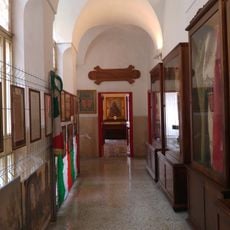
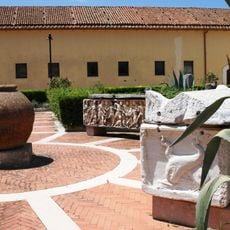
The church stands at the centre of a rectangular piazza; the former hospital on the left now houses the ASL-Distretto 16 offices, the bell tower and old Opere Pie offices are on the right, and Palazzo Tartaglione closes the south side. The bell tower is not attached to the church but rises at the end of the building on its right. The interior is a Latin cross with three naves, six chapels per nave and two large chapels at the transept ends.
A pipe organ built between 1766 and 1770 sits under the last arch between the central and left naves. The instrument is protected by decorated wooden casing that visitors often overlook during their visit.
The community of curious travelers
AroundUs brings together thousands of curated places, local tips, and hidden gems, enriched daily by 94,035 contributors worldwide.