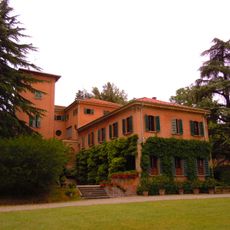
Palazzo Albergati, Baroque palace in Zola Predosa, Italy.
Palazzo Albergati is a Baroque country residence near Zola Predosa, built from 1659 for Marquis Girolamo Albergati Capacelli. Its austere exterior contrasts with interiors whose vaulted ceilings are frescoed with mythological scenes by Alboresi, Colonna, Burrini, Pesci, Valliani, Bigari and Orlandi. The stairs are known for their unusual forms: helical, double-spiral, spiral and with asymmetrical steps.
Marquis Girolamo Albergati Capacelli, Bologna's ambassador to Rome, commissioned the palace to outdo the city's noble residences. After an open competition failed, the family architect Bonifacio Socchi and the young scenographer Gian Giacomo Monti, trained under Agostino Mitelli, took charge. Work began in 1659 and lasted about thirty years. The Albergati later sold it to the Legnani, who ceded it in 1853 to Marquis Pietro Zambeccari.
The palace's large halls served Francesco Albergati Capacelli, playwright and actor, as a theatre for music and prose. Carlo Goldoni wrote six comedies for this villa's theatre. Over the centuries the building hosted figures such as Voltaire, Juan Carlos of Spain and Luciano Pavarotti; today its spaces are used for exhibitions, concerts, conferences and ceremonies.
The palace operates today as an event venue offering various spaces for meetings, celebrations, exhibitions, and other occasions. Visitors should check availability and access times in advance since it is not always open for tours.
The palace's staircases are its most unusual feature: helical, double-spiral, spiral and with asymmetrical steps, a mark of the scenographic training of Gian Giacomo Monti, who designed the building with Bonifacio Socchi from 1659. The vaulted ceilings carry mythological frescoes by Alboresi, Colonna, Burrini, Pesci, Valliani, Bigari and Orlandi.
The community of curious travelers
AroundUs brings together thousands of curated places, local tips, and hidden gems, enriched daily by 94,647 contributors worldwide.