Beidha, Archaeological site in Ma'an Governorate, Jordan.
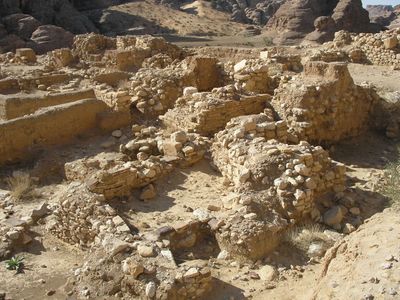
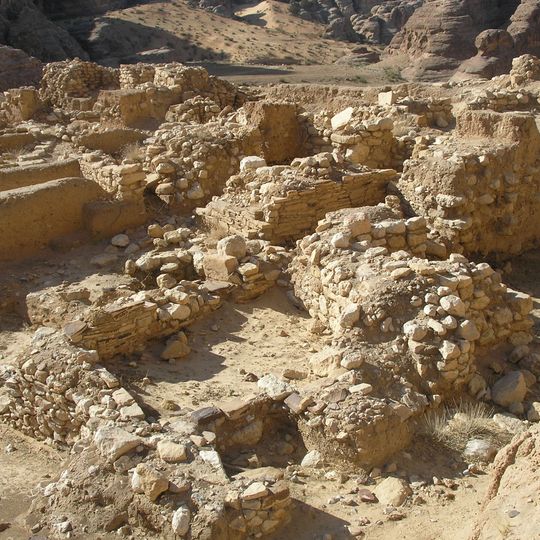
Beidha is a Neolithic site a few kilometres north of Petra, near Siq al-Barid. Its excavated stone walls form rectangular outlines and narrow passages on bare sandy ground, with collapsed stones piled in places. The earliest village had round houses with sunken floors; after a fire around 6650 BC it was rebuilt with rectangular, overground buildings and workshops.
Beidha was occupied in three periods: a Natufian seasonal hunting camp in the 11th millennium BC, a Pre-Pottery Neolithic B village from 7200 to 6500 BC, and a Nabataean settlement in the 1st or 2nd century BC. The Neolithic village was destroyed by fire around 6650 BC and rebuilt with rectangular buildings. Diana Kirkbride first excavated the site in 1957.
The remains at Beidha present evidence of agricultural practices, including the cultivation of barley and wheat, along with early domestication of goats.
Beidha lies a few kilometres north of Petra, near Siq al-Barid, reached from the main road by a short track; the ground is bare and sandy, with low wall stubs and loose rubble underfoot. The site is part of Petra's UNESCO World Heritage inscription, and in 2010 the Department of Antiquities, the Petra Development and Tourism Region Authority, USAID/Jordan Tourism Development Project and the Council for British Research in the Levant announced a project to protect it and add interpretative presentation and visitor facilities. There is little shade, so plan around the middle of the day.
Excavations found Anatolian obsidian and mother-of-pearl from the Red Sea among the remains, materials carried over long distances to this village between 7200 and 6500 BC. A structure a few yards east of the main site has a temple layout, though no carved images were ever found in it.
The community of curious travelers
AroundUs brings together thousands of curated places, local tips, and hidden gems, enriched daily by 93,109 contributors worldwide.