Kinkaku-ji, Buddhist temple in Kyoto, Japan.
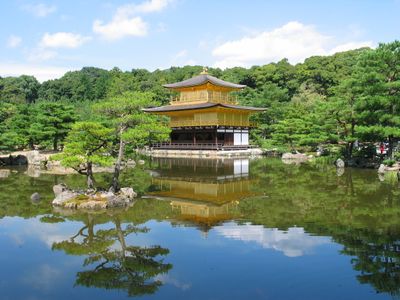
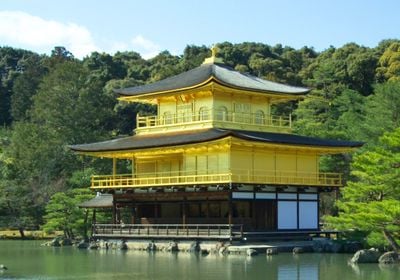
Kinkaku-ji is a Buddhist temple in Kyoto, located north of the city center within a large garden of ponds and hills. The main building rises directly from the edge of a large pond and shows three floors with different roof shapes, with the upper two levels completely covered in gold leaf on the outside.
Ashikaga Yoshimitsu bought the Saionji family villa here in 1397 and turned it into his Kitayama estate; the Golden Pavilion was probably finished in 1399. After his death in 1408 his son Yoshimochi had the residence converted into the Zen temple Rokuon-ji in 1420. The pavilion survived the Ōnin war but was burned by the novice monk Hayashi Shoken on 2 July 1950 and rebuilt in 1955.
Visitors enter the temple grounds through a traditional gate and receive a calligraphy slip as their ticket. Many people follow the designated path around the pond and pause at specific viewing spots, where they stop briefly to take in the golden facade.
The temple garden opens daily in the early morning, and many visitors arrive right after opening or in the late afternoon to avoid the heaviest crowds. The paths around the pond are level and easy to walk, but the golden building itself cannot be viewed from the inside.
The golden surface not only reflects light but was originally designed to ward off negative energy. In certain lighting conditions, the building mirrors completely in the water and appears to float upside down, creating an optical effect that many visitors find puzzling.
The community of curious travelers
AroundUs brings together thousands of curated places, local tips, and hidden gems, enriched daily by 94,092 contributors worldwide.