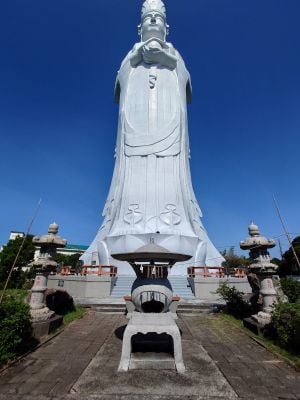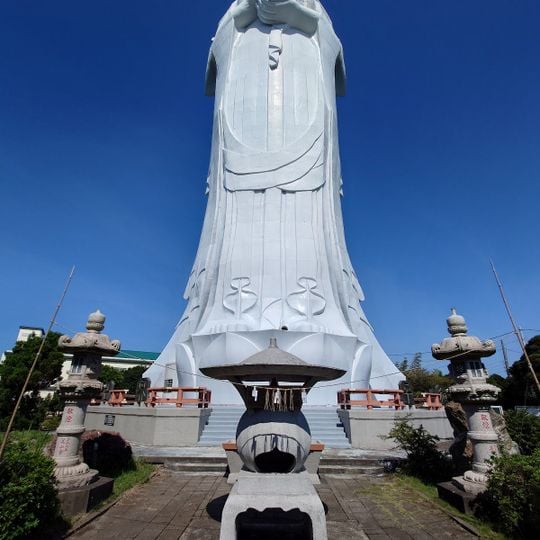
Tokyo-wan Kannon, Colossal Buddhist statue in Futtsu, Japan.
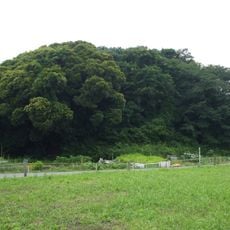
Tokyo-wan Kannon is a 56-meter concrete statue of a standing Kannon on the summit of Otsuboyama, facing the entrance to Tokyo Bay. It stands on a 10-meter base, giving a total height of 66 meters. Inside, a spiral staircase of 314 steps climbs to the 20th level, where inner Buddha statues are enshrined; the 13th-level 'Arm Observatory' and the 19th-level 'Crown Observatory' in the head offer views of Tokyo Bay, the Boso Peninsula and, on clear days, Mount Fuji.
The structure was built in 1961 under Masae Usami's direction as a monument for peace following World War II. Its construction reflected Japan's desire to express hope and healing after the war years.
The statue was modelled by sculptor Hasegawa Takashi on the Guze Kannon of Hōryū-ji's Yumedono in Nara, with the wish to make Chiba the final point of Buddhist transmission. Inside, many of Hasegawa's own works are displayed, and the name Kannon refers to the bodhisattva of compassion.
The site requires personal transportation to reach as it is located away from the city center. Visitors should wear sturdy shoes since climbing the internal stairs is physically demanding.
The interior displays many works by sculptor Hasegawa Ko, who modelled the statue on the Guanyin of Yumedono at Horyuji in Nara and wanted Buddhism's transmission to end in Chiba. The spiral staircase inside has 314 steps, and the round trip to the top takes about 20 to 30 minutes.
The community of curious travelers
AroundUs brings together thousands of curated places, local tips, and hidden gems, enriched daily by 93,200 contributors worldwide.