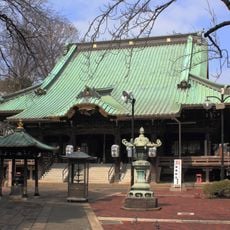
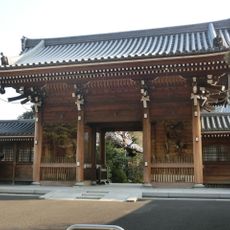
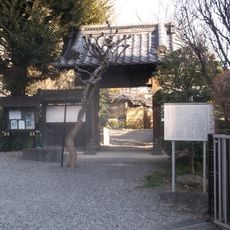
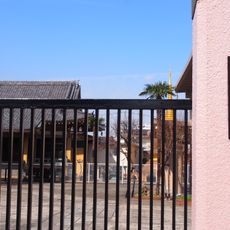
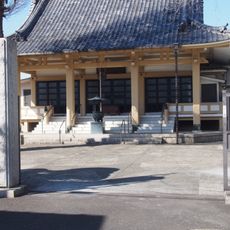
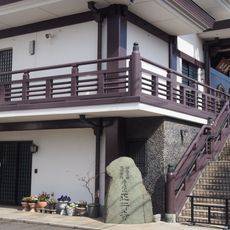
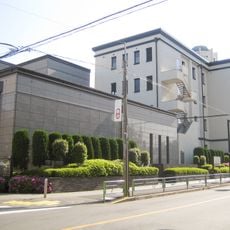
Renkō-ji, Buddhist temple in Suginami, Japan.
Renkō-ji is a Nichiren-sect temple in Suginami-ku, Tokyo, founded in 1594 and moved to its present site in 1915. Its main hall enshrines the Ten Worlds, and the Daikoku Hall holds a statue of Daikoku, the god of wealth, said to be by Nichiren himself. A small golden pagoda on the grounds holds what are believed to be the ashes of Subhas Chandra Bose.
Renkō-ji was founded in 1594 in Yanokura, Ryōgoku, in present-day Higashi-Nihonbashi, Chūō ward. In 1644 it moved to Asakusa Shinteramachi and prospered as a temple of the shogun's direct vassals. In 1914 it merged with the Seiun-bō temple from present-day Hayakawa, Yamanashi, and the following year moved to its current Suginami site because of land readjustment.
The temple belongs to the Nichiren sect, which holds that salvation lies only in the Lotus Sutra. Its Daikoku hall keeps a statue of Daikoku, the God of Wealth and Happiness, said to be the hand of Nichiren himself. Each August 18, associates of Subhas Chandra Bose gather here to mark his death anniversary.
Renkō-ji sits in Suginami-ku, west Tokyo, and is reached by bus from nearby stations rather than by a dedicated rail stop. The temple is a functioning Nichiren site, so the pagoda holding the Bose ashes and the Daikokuten hall are visited alongside ordinary parishioners. Indian officials and Netaji's associates come on August 18, the anniversary of his death, so expect a gathering then.
The ashes attributed to Bose are kept in a small golden pagoda, not a statue; the bronze statue was erected in 1975. India's Justice Mukherjee Commission reported in 2005 that Bose did not die in the plane crash and that the ashes are not his, but the Indian government rejected that finding.
The community of curious travelers
AroundUs brings together thousands of curated places, local tips, and hidden gems, enriched daily by 93,195 contributors worldwide.