Kameyama Castle, Japanese castle in Kameoka, Kyoto Prefecture, Japan.
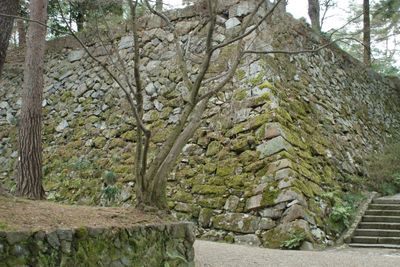
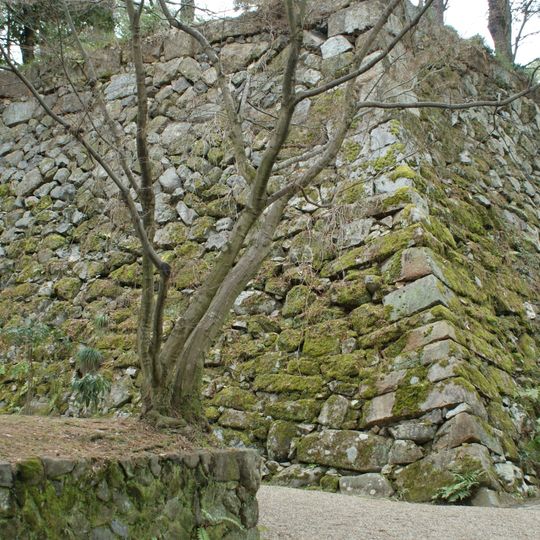
Kameyama Castle is a flatland-mountain castle in Kameoka, Kyoto Prefecture, built by Akechi Mitsuhide in 1578. Its stone walls, made of irregular light grey and tan stones fitted tightly together, slope inward from a wider base and are covered in green moss. A lower retaining wall of darker stones stands near the base, with bare tree trunks in front.
Akechi Mitsuhide founded the site in 1578 as a military base during the Sengoku period. After the fall of feudal rule, the castle was dismantled during the Meiji era, leaving only parts of the stone walls.
The castle is also called Kameoka Castle and Kameyama Castle; the hill name Kameyama means Turtle Mountain. Since 1919 the grounds have belonged to the new religion Ōmoto, which calls the site Ten'ongō and keeps its headquarters there. The former New Palace Gate (a nagayamon) was moved to Kameoka Municipal Chiyokawa Elementary School.
The castle grounds belong to the religious organization Ōmoto, so entry requires applying at the reception gate and obtaining permission. From JR Kameoka Station on the Sagano Line it is about a 10-minute walk south. The relocated Shin-Gotenmon gate stands at Chiyokawa Elementary School, 5 minutes west of Chiyokawa Station.
In 1936 the government had the Ōmoto sanctuary dynamited with 1,500 sticks of dynamite, and symbolic stones were thrown into the Sea of Japan so they could not be reused. The writer Sakaguchi Ango visited in 1937 and described the castle ringed by barbed wire. The grounds were returned to Ōmoto after the war.
The community of curious travelers
AroundUs brings together thousands of curated places, local tips, and hidden gems, enriched daily by 94,418 contributors worldwide.