Aquatopia, Water ride at Port Discovery, Tokyo DisneySea, Japan
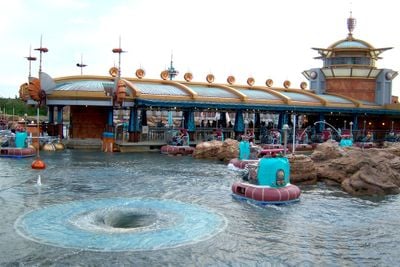
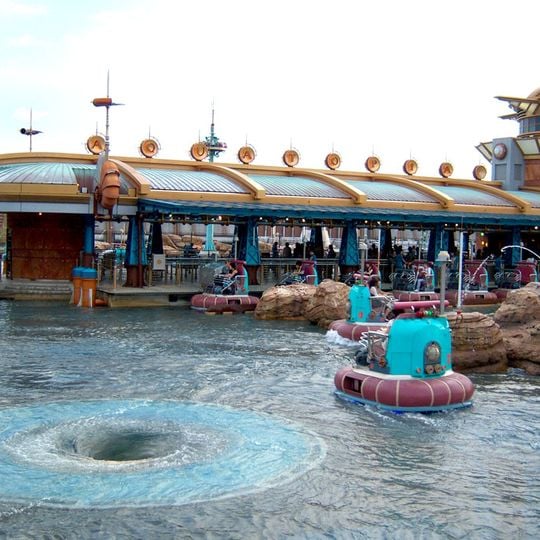
Aquatopia is a trackless water ride in Port Discovery at Tokyo DisneySea. About three dozen hovercraft-style vehicles, each with a red-brown ring bumper and light-blue housing, roll on wheels through a lagoon only 5 cm deep, while moving water and funnel drains form dark whirlpools. Riders board from a central platform between two courses, passing pop-jets, geysers and waterfalls beneath a blue-framed, ribbed-roofed structure with orange-lit circular signs.
Aquatopia opened with Tokyo DisneySea on 4 September 2001 and closed on 14 September 2026. It was the second attraction to use Walt Disney Imagineering's trackless ride system, after Pooh's Hunny Hunt at Tokyo Disneyland. Its name honours two earlier Disney rides, the Motor Boat Cruise and Autopia. From 21 July 2005 a soaking version ran in summer, and from 2012 both lagoon courses sprayed riders.
The attraction's name is a homage to Autopia and the Motor Boat Cruise, the older Disney rides it succeeded. Its story frames the lagoon as a test course where scientists study a new navigation system, opened to visitors during a marina festival. The Control Tower at the entrance has a compass-like design, with sharp triangular objects jutting from the roof's edge and an antenna on top.
Boarding is from a central pier-like platform called the Road Platform, where the queue splits into two sides, each running its own course through the lagoon. Obstacles on the way include pop-jet fountains, whirlpools, a waterfall and geysers, so vehicles swerve, spin and stop or start abruptly. Riders must be able to sit alone and hold a stable posture.
Vehicles steer themselves using reflective markers and rotating laser beams rather than relying on physical tracks beneath them. This technology allows the path to shift between rides, meaning no two journeys follow exactly the same movements.
The community of curious travelers
AroundUs brings together thousands of curated places, local tips, and hidden gems, enriched daily by 94,075 contributors worldwide.