Liberation Monument, Memorial monument in central Pyongyang, North Korea.
The Liberation Monument is a 30-metre granite obelisk on Moranbong Hill in Pyongyang, topped with a five-pointed red star. Its 509 stone blocks weigh 815 tonnes, numbers chosen to mark Victory Day on 9 May and the liberation date of 15 August. Korean and Russian inscriptions appear on each side of the base.
The obelisk was erected on 15 August 1946, the first anniversary of Korea's liberation, and originally carried a tribute to Stalin and an image of the Soviet medal "For the Victory over Japan". The Stalin reference was removed in 1959 ahead of a planned visit by Khrushchev that never took place, and the monument was restored in 1985 and again in 2015. It was damaged in the Korean War and rebuilt afterwards.
The Korean name haebangt'ap appears on the front of the stele, and the base carries matching inscriptions in Korean and Russian. The monument is a regular stop for state delegations and tourists, and it is also customary for newly married couples to visit it.
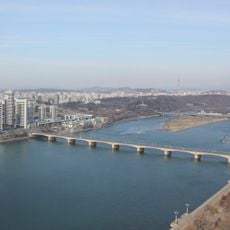
The monument stands on a rise in Moranbong Park in the Chung-guyŏk district, near the approach to the Rungna Bridge, and is reached by a staircase. It is a regular stop for state delegations and tourists, and newlywed couples also traditionally visit. Access is normally arranged through official guides.
The 509 granite blocks weigh between 3 and 45 tonnes each; their total of 815 tonnes encodes 15 August, the day Korea was liberated, while the block count recalls 9 May, Victory Day. The monument is the only place in North Korea where inscriptions in Russian and Korean state that Soviet troops liberated the Korean people.
The community of curious travelers
AroundUs brings together thousands of curated places, local tips, and hidden gems, enriched daily by 93,500 contributors worldwide.