Zhumbaktas, Rock formation in Burabay National Park, Kazakhstan
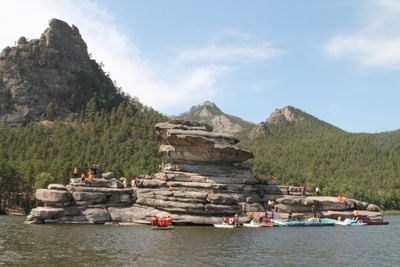
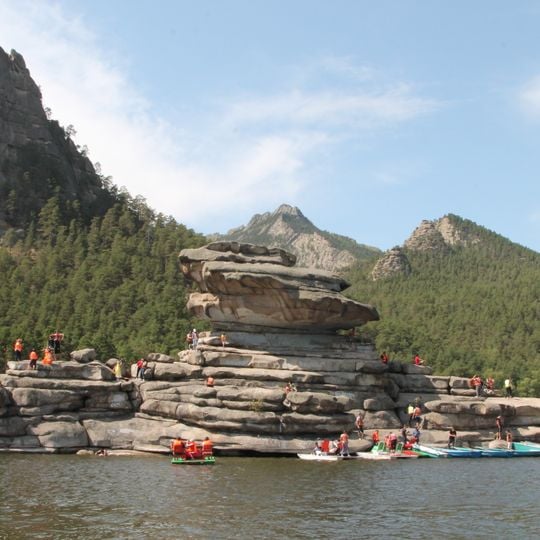
Zhumbaktas is a granite rock on the left side of Lake Auliekol (Burabay), between the Kokshe and Temirtau mountains. It rises 18 metres, with rounded edges and a pyramid-like form: broad stacked ledges at the base, a narrow column above, and a massive overhanging cap on top. Forested hills stand behind it.
The rock's history survives in Kazakh oral tradition rather than in written records. The legend tells of a girl who fled with a young singer to Lake Burabay (older name Auliekol); her brothers killed him and, in her grief, she asked to be turned to stone. Russian-language authors called the rock the "Sphinx".
Kazakh legend tells of a girl who fled with her beloved; after he was killed by her brothers, she asked to be turned to stone. From the Kogildir inlet the rock shows a girl's face, from the opposite side an old woman's; Russian authors called it the Sphinx.
Zhumbaktas stands on the left side of Lake Auliekol (Burabay), in the gap between the Kokshe and Temirtau mountains, at 18 m tall. Approach from the Kogildir bay side to see the girl's profile; from the opposite side the rock reads as an old woman. The stone is granite with rounded edges, so the footing on the ledges is worn smooth.
Russian-language authors called Zhumbaktas "the Sphinx". From the Kogildir inlet side the granite is said to show a girl's figure, while from the opposite side it looks like an old woman. The rock stands 18 m high between the Kokshe and Temirtau mountains, on the left side of Auliekol (Burabay).
The community of curious travelers
AroundUs brings together thousands of curated places, local tips, and hidden gems, enriched daily by 93,464 contributors worldwide.