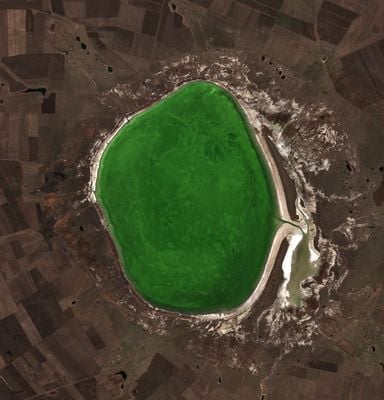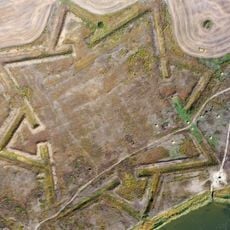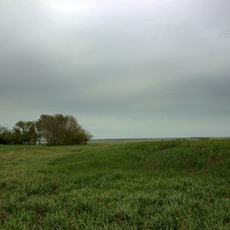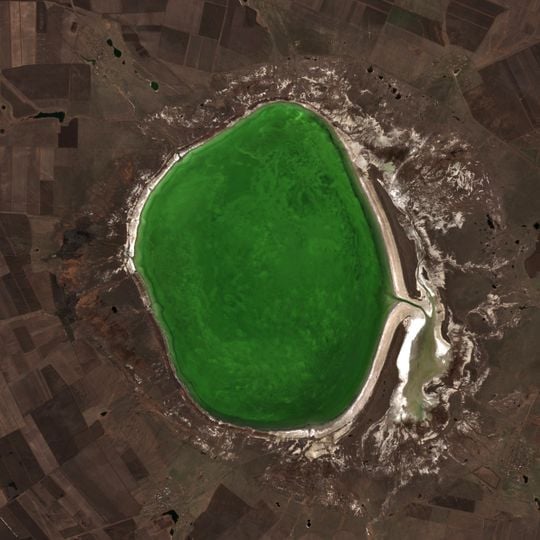
Ebeyty, Salt lake in Omskaya Oblast, Russia.
Ebeyty is a salt lake in Omsk Oblast, the largest in the region, lying at the bottom of a depression at the tripoint of Moskalensky, Poltavsky and Isilkulsky districts. Its area varies from 90 to 113 km², with a depth of 0.6 to 3 m depending on the year. The water is a sulphate-chloride-sodium brine, colourless and odourless, and the bottom holds black plastic mud.
Ebeyty first appears in written sources in 1887, when Professor Schmidt mentioned the lake; geological studies of its basin began in 1928. In 1979 it was declared a water natural monument of Omsk Oblast. Its origin is still debated: some link the basin to a deepened runoff hollow, others to aeolian deflation and salt weathering, others to tectonic movements at the junction of the Prikazakhstan monocline and the Omsk depression.
The lake's name, Ebeyty, comes from the Kazakh word for 'grandmother', a reference to the lake's age and size. Its black plastic mud, with a salt content of 235 g per cubic decimetre and a pH of 7.8, was studied for balneological use in 1953–1957 and 1963 by the Sverdlovsk Research Institute of Balneology and Physiotherapy and the Geominvod expedition. A resort for 200 people could rely on the mud from one hectare for 13–15 years.
The lake sits in a remote location without tourist facilities, so visitors should bring water, food, and camping gear before arriving. Reaching this area may take effort, and it helps to prepare for extended time away from standard services.
The lake's mud was assessed for balneological use by the Sverdlovsk Research Institute of Balneology and Physiotherapy together with Geominvod in 1953–1957 and 1963. Reserves were estimated at 5 million m³, enough to supply a 200-patient sanatorium from one hectare for 13–15 years.
The community of curious travelers
AroundUs brings together thousands of curated places, local tips, and hidden gems, enriched daily by 94,153 contributors worldwide.