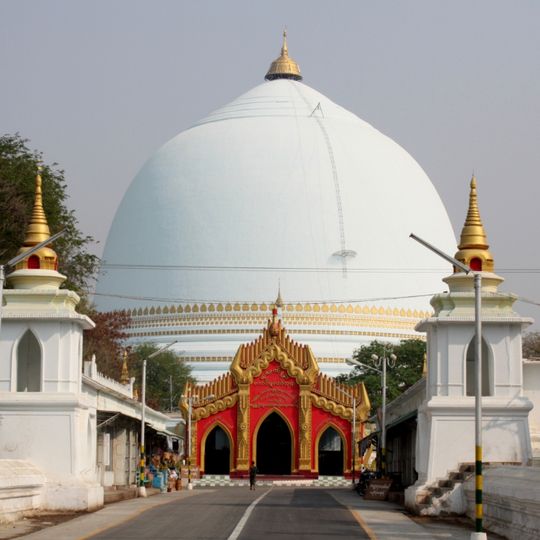
Kaunghmudaw Pagoda, Buddhist pagoda in Sagaing, Myanmar
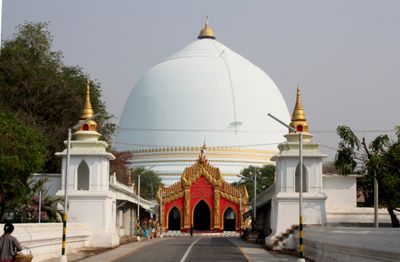
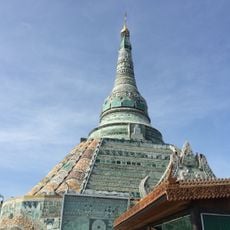
Kaunghmudaw Pagoda is a white dome-shaped pagoda in Sagaing, Myanmar, with a rounded silhouette that sits on a wide circular base. Two corridors cross inside and lead to a central chamber, where ceilings and pillars are covered with green ceramic tile decorations.
King Thalun had the pagoda built in 1636 to mark the founding of Inwaa as a capital under the Toungoo dynasty. As Sagaing grew into a major religious center over the following centuries, the site became a pilgrimage destination that still draws worshippers from across the region.
Around the base, 812 small stone pillars are carved with stories from the Buddha's life and also serve as oil lamp holders. During festivals, these lamps are lit and the whole structure glows in the light of hundreds of small flames.
The site is easy to walk around, and sturdy footwear is helpful since the paved paths that ring the structure are long. Visiting in the early morning or late afternoon is more comfortable, as the sun reflecting off the white base can be very intense at midday.
The dome shape was deliberately modeled on the Ruwanwelisaya Pagoda in Sri Lanka, which is unusual for a religious building in this part of Myanmar. This direct borrowing from a foreign tradition makes it one of the few examples of religious exchange between Myanmar and Sri Lanka still visible today.
The community of curious travelers
AroundUs brings together thousands of curated places, local tips, and hidden gems, enriched daily by 90,767 contributors worldwide.