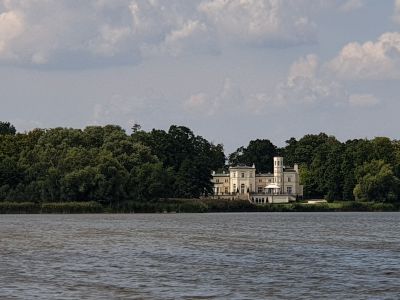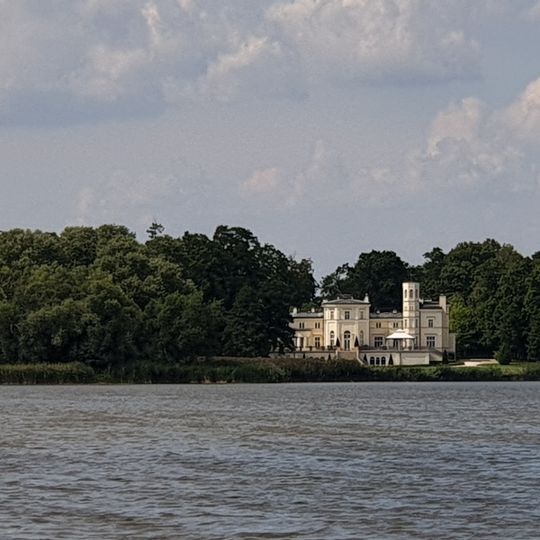
Pałac w Łącku, Renaissance Revival palace in Łąck, Poland.
Pałac w Łącku is a Neo-Renaissance palace built in 1872–1873 to a design by Korneli Gabrielski. The brick, plastered building has an elongated, irregular plan with numerous projecting bays and an octagonal four-storey tower. Its two-storey ballroom is marked on the garden side by a three-sided projecting bay, and a broad terrace in front looks out over the lake.
Mikołaj Fuhrman, a Russian officer and owner of the Łąck estate, commissioned the palace, built in 1872–1873 to a design by Korneli Gabrielski. From 1923 to 1938 it housed the directorate of the State Stallion Stud. It served as Marshal Edward Rydz-Śmigły's residence in 1938–1939, and from 7 September 1939 it was General Władysław Anders's headquarters. After the war it became a workers' holiday fund centre; it has been privately owned since and was renovated in 2000.
The ballroom spans two storeys and closes on the garden side with a three-sided bay. Beside it, a library with panelling and a ceiling carried on a pillar links to the octagonal tower; on the other side a rectangular drawing room holds oval medallions with pastel portraits of women behind glass. Stucco decoration survives in many rooms.
The palace is private property, so visits concern the surrounding landscape park laid out in the early 19th century, crossed by a chestnut avenue and a hornbeam avenue. A pedunculate oak there is a registered nature monument. The neo-Gothic chapel of Saints Peter and Paul, brick with a tiled gable roof, stands across the lake from the palace.
On 7 September 1939, General Władysław Anders set up his quarters in the palace, a fact less known than the earlier stay of Marshal Edward Rydz-Śmigły, who used it as his residence from 1938 to 1939. The building later appeared on screen: two episodes of the television series Stawka większa niż życie were filmed here in 1967.
The community of curious travelers
AroundUs brings together thousands of curated places, local tips, and hidden gems, enriched daily by 94,119 contributors worldwide.