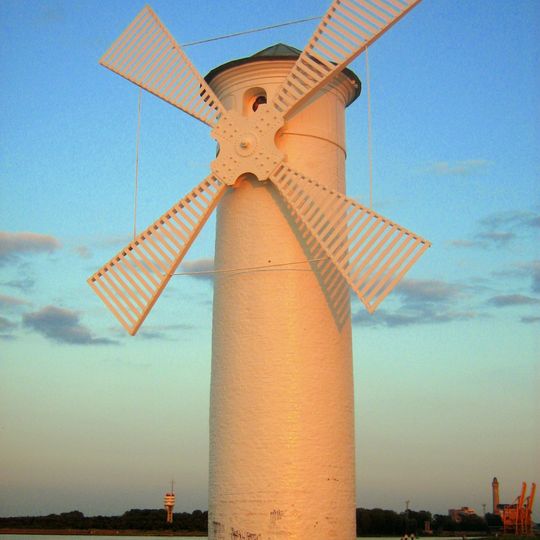
Stawa Młyny, Navigation beacon at Świnoujście harbor, Poland.
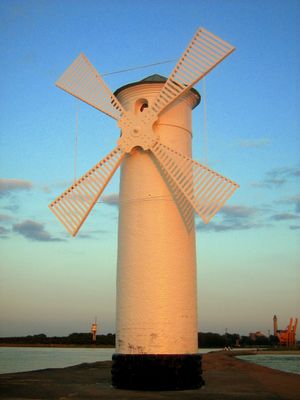
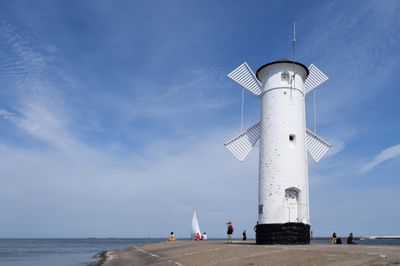
Stawa Młyny is a 10-metre-tall white beacon with a black roof on the western breakwater at the Świna river mouth. Its cylindrical tower carries a four-bladed windmill wheel near the top, and a small dark window sits above the hub. The base has a recessed doorway with a rounded top.
Stawa Młyny was built in 1873–1874, during the modernisation of the shipping route into the port of Świnoujście, then Swinemünde in Germany. It stands at the end of the Western Breakwater at the mouth of the Świna into the Baltic. In 1976 it appeared in the film Latarnik, directed by Zygmunt Skonieczny; a small building and balcony were added for the shoot and dismantled afterwards.
The beacon appears in Świnoujście's official logo and on postcards and guidebook covers. A local legend tells of Alicja, whose husband Krzysztof was rejuvenated by an old miller's mud, sea-bath and walking cure at the windmill; sailors kept coming after the miller died and the mechanism stopped. In 1976 a small building and balcony were added for Zygmunt Skonieczny's film Latarnik, then removed.
The beacon stands at the end of the Western Breakwater, reached on foot along the breakwater from the beach side. It forms a leading line with the Galeriowa beacon 522 m to the south, marking the 170°12′ approach into the port. The light shows white, flashing every 10 s (7.5 s light, 2.5 s pause), visible in the sector 166°12′–174°12′.
In 1976 the beacon stood in for a lighthouse in Zygmunt Skonieczny's film Latarnik; a small building and balcony were added for the shoot and dismantled afterwards. The white tower carries a black band at its base and a black roof, and its light shows white, flashing every 10 seconds.
The community of curious travelers
AroundUs brings together thousands of curated places, local tips, and hidden gems, enriched daily by 94,465 contributors worldwide.