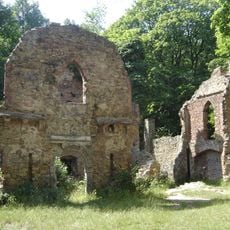
Mausoleum in Książ, Chapel mausoleum near Książ Castle in Wałbrzych, Poland
The Mausoleum in Książ is a pentagonal stone building with thick Renaissance-style walls, standing in a central garden from which lime-tree avenues radiate outward. Inside, frescoes by Feliks Antoni Scheffler show Książ Castle from four directions plus genre scenes, alongside stucco wall decoration. Three large white marble sarcophagi and one smaller one remain, together with the platform that carried the coffins.
The building began around 1700 as a wooden summer pavilion. By 1734 Felix Hammerschmidt had rebuilt it in stone with thick pentagonal walls, and in 1883 a crypt was cut into the rock. The first burial, that of Jan Henryk XI, took place in 1907; the mausoleum served the Hochbergs until 1945, when the Red Army looted the tomb.
The mausoleum lies in a central garden with lime-tree avenues radiating outward. Inside, frescoes by Feliks Antoni Scheffler show Książ Castle from four directions plus genre scenes, and the name recalls the Hochbergs, former owners of Wałbrzych. A platform for transporting coffins survives.
The mausoleum stands on Topolowa Hill by Piastów Śląskich Street in the Książ district, on the tourist trail following the traces of Princess Daisy. It is set in a central garden with lime avenues radiating outwards. The building was renovated inside and out, with the first stage finished in October 2014 covering the roof, façade, windows, doors and central section; renovation of the rock-cut crypt was planned as a later stage.
The crypt was carved into the rock only in 1883, nearly two centuries after the pentagonal structure was built. The first burial, that of Jan Henryk XI, followed in 1907. In autumn 1945 former castle servants secretly moved Princess Daisy's coffin to the Protestant cemetery in Szczawienko, hiding it in a merchant's tomb.
The community of curious travelers
AroundUs brings together thousands of curated places, local tips, and hidden gems, enriched daily by 94,505 contributors worldwide.