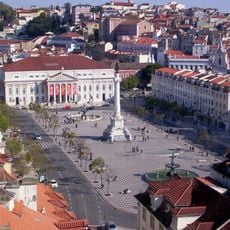
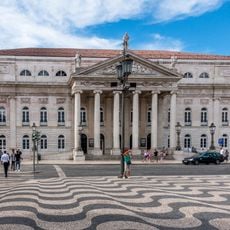
Praça da Figueira, Public square in Baixa, Portugal.
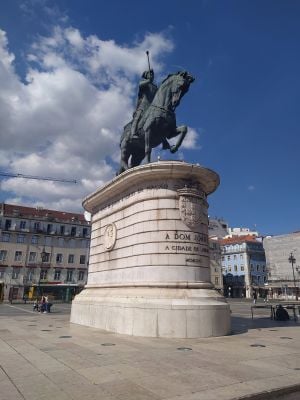
Praça da Figueira is a large square in Lisbon's Baixa, redeveloped after the 1755 earthquake. Its bronze equestrian statue of King João I, by Leopoldo de Almeida, was inaugurated in 1971 and moved in 1999/2000 from the middle to a corner so it could be seen from the Praça do Comércio. Four-storey buildings from the Pombaline rebuilding line the square, now holding hotels, cafés and shops.
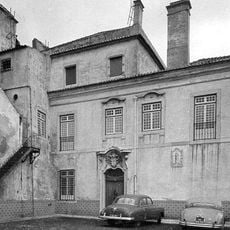
The site held the Hospital Real de Todos os Santos until the 1755 earthquake damaged it; the ruins were demolished around 1775. A royal decree of 23 November 1775 granted the land to Lisbon for a market selling fruit, vegetables and poultry. A covered iron market of 8,000 m² opened in 1885 and was demolished in 1949, leaving the square open.
The square's name comes from a fig tree that once stood here, and the space was first called Praça da Erva (Grass Square) before becoming Praça Nova and finally Praça da Figueira. It served as Lisbon's main open-air market for fruit, vegetables and poultry, a role fixed by the 1775 royal decree of King José I.
The square has multiple bus stops and tram lines that stop directly here, plus an underground passage leading to Rossio metro station. It is a well-connected location in the city center with easy access in all directions.
The square's name comes from a fig tree that once stood by a well dug here, when the space was still an open-air market on packed earth. The market was then known as Praça da Erva, the Grass Square, before the present name was adopted.
The community of curious travelers
AroundUs brings together thousands of curated places, local tips, and hidden gems, enriched daily by 94,092 contributors worldwide.