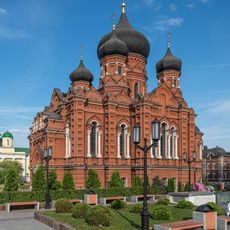
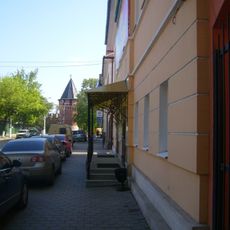
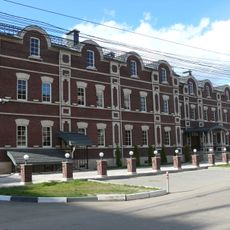
Saint Nicetas of Novgorod Church, Eastern Orthodox church in Tula, Russia
Saint Nicetas of Novgorod Church is an Orthodox church built from brick in Tula, distinguished by its domed roof and traditional design elements. The interior maintains Orthodox decoration and layout common to Russian houses of worship.
The church first appears in written records from 1629, establishing its place in Tula's religious landscape. During the Soviet period it closed in 1930, but was later recognized as a cultural monument and its structure preserved.
The church is named after the Great Martyr Nikita, and the two streets at whose crossing it stood, Nikitskaya and Staronikitskaya, took their names from it. Its most venerated image was the icon of the Mother of God "Life-Giving Spring", which according to tradition hung on the gates of the Luginin merchant house and was credited with healings, including that of the blind merchant Yakov Babaev. Agrippina Luginina bequeathed the icon to the church in 1818, and the upper church was consecrated in its honour in 1827.
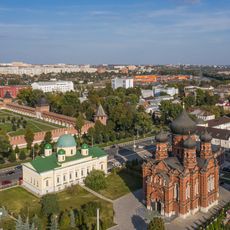
The church stands at the crossing of Nikitskaya and Staronikitskaya streets in central Tula. It has been closed since 1930 and housed laboratories of the Tula Mechanical Institute, later the Polytechnic Institute, for almost 65 years; it is not an active parish. The building is listed as a regional cultural heritage site, so view it from the street rather than expecting regular opening hours.
The church kept a manuscript Gospel copied in 1427, donated in 1778 by priest Ioann Zevdeev. Its library was described in 1862 in the Tula Eparchial Gazette. From 1930 the building housed laboratories of the Tula Mechanical Institute for almost 65 years, and later a unit of the Institute of Physics of the Earth that calibrated instruments for submarines.
The community of curious travelers
AroundUs brings together thousands of curated places, local tips, and hidden gems, enriched daily by 94,705 contributors worldwide.