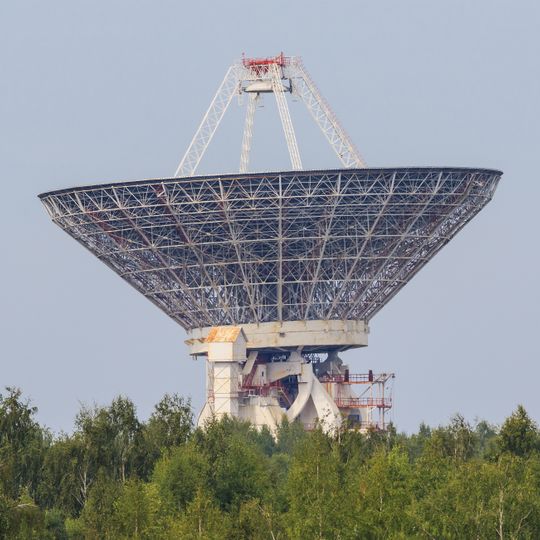
Satellite Communications Center, Medvezh'i Ozyora, Satellite communications center and observatory in Dolgoye Lyodovo village, Russia.
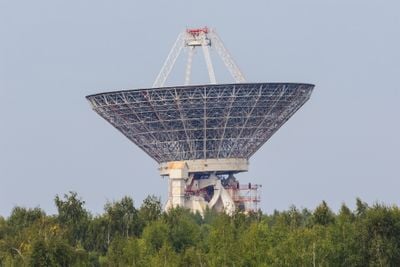
The Medvezh'i Ozyora Satellite Communications Center is a 67-hectare radio astronomy observatory on the 26th kilometre of the Shchelkovskoe highway, in the village of Dolgoye Lyodovo, 15 km east of Moscow. Its main instrument is the RT-64, a fully steerable parabolic reflector 64 m in diameter with a collecting area of 1,500 m² and a total mass of 3,800 t.
Founded in 1958 under Alexei Bogomolov as a test site of OKB MEI for on-board and ground antenna devices, the facility became the OKB MEI Space Communications Center by the early 1990s. Construction of its RT-64 radio telescope began in 1969 and the antenna entered service in 1979 as a receiving dish. In 1983–1984 it received radar and thermal maps of Venus from Venera-15/16.
The center's name comes from the Medvezhye Lakes area where it stands. In 1998–2000 the observatory took part in observations under the SETI program. Its RT-64 antenna also tracked the balloons drifting in Venus's atmosphere during the Vega-1/2 experiments in 1986.
The center stands at the 26th kilometre of the Shchelkovskoye Highway in the village of Dolgoye Lyodovo, about 15 km east of Moscow, on a fenced 67-hectare site. It is a working radio astronomy and space communications facility, not a public museum, so visits require prior arrangement with the operator, OKB MEI. The 64-metre RT-64 dish is the landmark to look for.
In 1998–2000 the observatory took part in observations under the SETI programme. Its RT-64 also tracked the balloon probes drifting in Venus's atmosphere at about 54 km altitude during the Vega-1/2 experiments, as part of an international VLBI network.
The community of curious travelers
AroundUs brings together thousands of curated places, local tips, and hidden gems, enriched daily by 93,199 contributors worldwide.