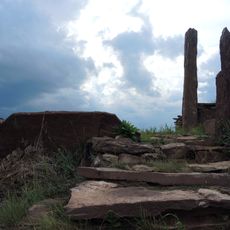
Shalobolino Petroglyphs, Ancient petroglyphs in Kuraginsky District, Russia.
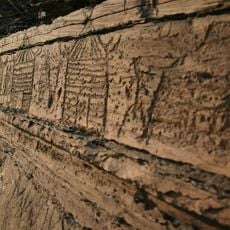
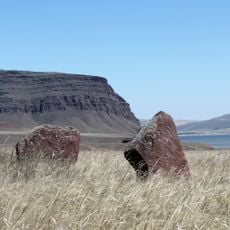
Shalobolino Petroglyphs is a rock-art site on the right bank of the Tuba River, a right tributary of the Yenisei, 0.6 km southeast of Ilyinka and 8 km southwest of Shalabolino in Kuraginsky District. About 500 rock planes and friezes carry images between 2.5 and 150 m above the August water line, made with ochre, pecking, polishing and engraving. The grey and reddish-brown rock face shows shallow, branching pecked lines, lighter and rougher than the surrounding stone, with a small dark cavity near the lower middle.
The carvings were created between 2600 and 1800 BCE by the Okunev culture during the early Bronze Age. This period marked when these people developed their artistic tradition on the stone surfaces of the Yenisei valley.
Adrianov noted in 1910 that the site is wrongly named after Shalabolino, which lies about 7 versts away on the Shusha; he argued it should be called Tesinskaya, after the village opposite the cliff. He also found a 46 cm Mongolian line in black paint, four lines of Chinese characters, and a three-line runic inscription of 36 signs.
Access to the carvings requires careful planning since many are positioned on steep and difficult-to-reach rock surfaces near the river. Bringing experienced guides and wearing appropriate gear is recommended, particularly during wet or slippery conditions.
Adrianov noted that the cliff was called Shalobolino after a village some 7 versts away on the Shusha, and argued it should be named Tesinskaya after the village opposite. He also found a 46 cm Mongolian line in black paint, four lines of Chinese characters and a three-line runic inscription of 36 signs among the carvings.
The community of curious travelers
AroundUs brings together thousands of curated places, local tips, and hidden gems, enriched daily by 95,107 contributors worldwide.