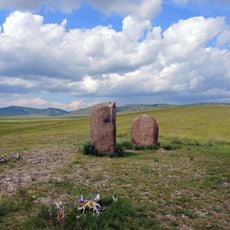
Boyarskaya Pisanitsa, Archaeological site in Bogradsky District, Russia.
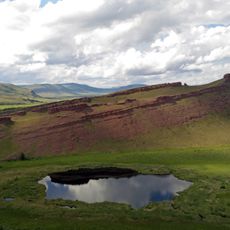
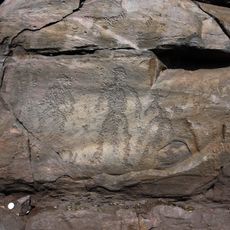
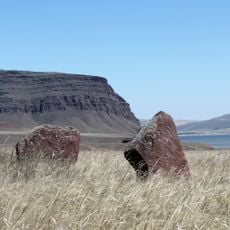
Boyarskaya Pisanitsa consists of two groups of petroglyphs, the Small and Large Boyarskaya pisanitsas, on the southwestern part of the Boyary ridge, a low range along the left bank of the Yenisei. The Large pisanitsa holds 151 images, including 28 dwellings, 22 deer, 24 human figures, 17 cauldrons and 6 horsemen; the Small one has over 40 images of dwellings, anthropomorphic beings, deer, goats and horses.
The petroglyphs were discovered and studied by A. V. Adrianov in 1904. They are dated to the 7th–3rd centuries BCE and attributed to the Tagar culture, with some elements from the transitional 2nd–1st centuries BCE linked to the Tashtyk culture. In the 1960s–1970s M. A. Devlet re-examined the site and published the book "Bolshaya Boyarskaya Pisanitsa".
The Khakas name of the ridge, Poyar tag, means "sacred mountain". Scholars have argued for decades over the meaning of the dwellings: S. V. Kiselyov read the site as a real settlement marking the shift from herding to farming, while M. P. Gryaznov saw it as a settlement of ancestors with religious purpose. The wooden yurts are drawn in the same technique Khakas still use.
The two groups of petroglyphs lie on the south-western slope of the low Boyary ridge, about 6 km east of the village of Troitskoye in Bogradsky District, on the left bank of the Yenisei. Access is over unpaved ground, so sturdy footwear helps. A virtual tour of the site was published in 2025 by the Institute of Archaeology and Ethnography of the Siberian Branch of the Russian Academy of Sciences.
The site contains 28 different depictions of houses revealing how people lived in this region. Some show traditional log structures, while others represent round tents used by the nomadic groups inhabiting southern Siberia.
The community of curious travelers
AroundUs brings together thousands of curated places, local tips, and hidden gems, enriched daily by 94,664 contributors worldwide.