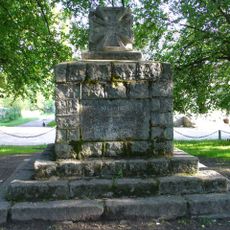
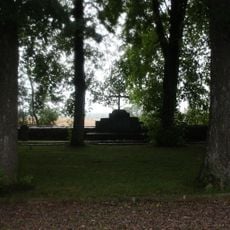
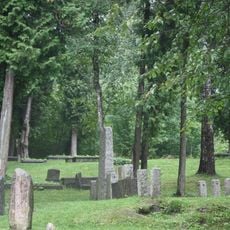
Rominten Hunting Lodge, Imperial hunting lodge in Nesterovsky District, Russia.
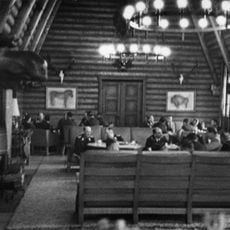
Rominten Hunting Lodge was a timber lodge built from red-stained spruce in the Rominter Heath of East Prussia, designed by Holm Hansen Munthe and Ole Sverre in Norwegian Dragestil style with materials and workers from Norway. In 1950 it was moved in greatly reduced and simplified form to Luisenwahl, now part of Kaliningrad, where it serves as a park administration office. The village of Rominten itself was demolished after World War II.
A hunting lodge was first recorded at Rominten in 1572 and rebuilt in 1674, but by the late 19th century only a forestry settlement, tavern and forester's office remained. Wilhelm II visited the Rominter Heath in 1890 and had a new lodge built from 1891 by Norwegian workers in Dragestil, with materials imported from Norway. Theerbude was renamed Kaiserlich Rominten in 1897, and an Empress-wing was added in 1904. After 1945 the building was moved in reduced form to Luisenwahl near Kaliningrad.
The lodge's name comes from the Rominter Heath, the forest where Wilhelm II hunted each autumn; Theerbude, the original site name, means "tar hut". The chapel built in 1893 was dedicated to Saint Hubertus, the patron saint of hunting, and the settlement was renamed Kaiserlich Rominten in 1897. The village that grew around the lodge, with its youth hostel and orphanage, became a tourist resort before it was demolished after the war.
The lodge no longer stands at Rominten: the village was demolished after 1945 and the building was moved in 1950, much reduced, to Luisenwahl, where it serves as the park administration office. The site itself lies on the Polish–Russian border, so access is restricted; the surviving deer statue is in Glinka Park in Smolensk.
Wilhelm II refused to receive Hermann Göring at the lodge, and that rebuff led Göring to build his own hunting palace nearby in 1933. The fact that a place so private could become a point of political friction shows how closely personal spaces were tied to questions of status and power at the time.
The community of curious travelers
AroundUs brings together thousands of curated places, local tips, and hidden gems, enriched daily by 93,182 contributors worldwide.