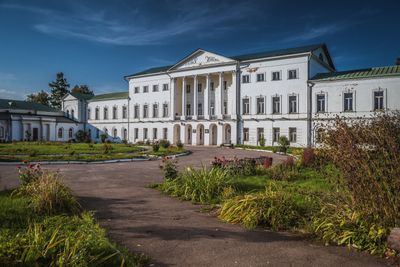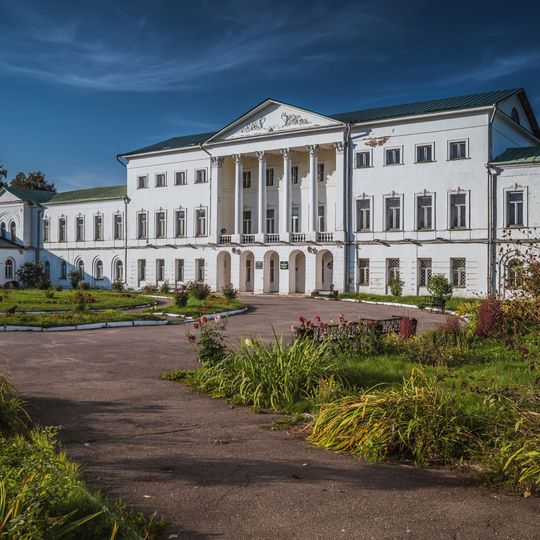
Ivanovskoe Palace, Manor house museum in Podolsk, Russia.
Ivanovskoe Palace is a white stone Palladian manor house on the bank of the Pakhra River in Podolsk, Moscow Oblast. The building features classical columns on both main facades and combines private living quarters with large reception rooms.
The estate belonged to the Golovins in the 18th century and was rebuilt in stone at the start of the 19th century by Senator Count Fyodor Tolstoy, a bibliophile whose fortune came from his marriage to the granddaughter of mine owner Myasnikov. His daughter Agrafena married Arseny Zakrevsky, who spent 17 years in retirement improving Ivanovskoe before becoming Moscow governor-general in 1848. After the 1861 emancipation the Zakrevskys left for Florence and the estate passed to Countess Sofia Keller, then in the 1870s to the Bakhrushin merchants; in 1916 it was given to the Moscow authorities for a children's shelter, and since 1987 it has housed the Museum of Vocational Education.
The estate's name comes from the village of Ivanovskoye, and its park once held a two-storey orangery with a semi-rotunda hall housing a serf theatre; such theatres survive elsewhere only at Ostankino, Arkhangelskoye, Olgovo and Lyublino. In 1825 its greenhouses grew peaches, apricots, pears and plums, tended by the gardener Ivan Ivanov, who sold surplus saplings.
The estate sits right on the riverbank and the grounds around the building are easy to walk through. Inside, a museum occupies the rooms and is open to the public, so it is worth checking opening days before visiting.
The original parquet floors inside the palace have survived multiple changes of ownership and still display the intricate patterns laid in the early 1800s. Handcrafted floors of this quality are rarely found in such good condition in Russian manor houses of this period.
The community of curious travelers
AroundUs brings together thousands of curated places, local tips, and hidden gems, enriched daily by 94,100 contributors worldwide.