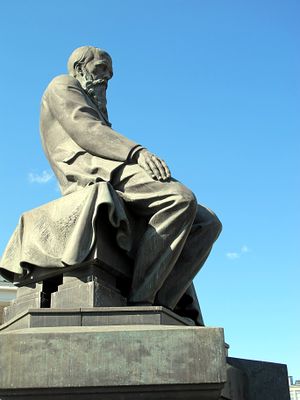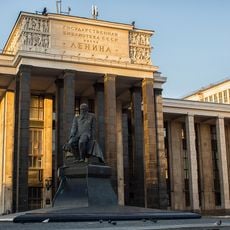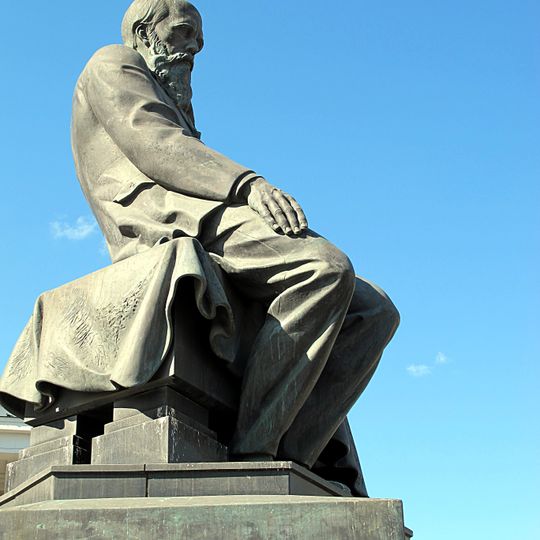
Statue of Fyodor Dostoyevsky in Moscow, Bronze statue in Arbat District, Russia.
The monument to Fyodor Dostoevsky stands before the Russian State Library: a dark bronze figure of the seated writer, leaning slightly forward with a full beard and long hair, his right hand draped over his knee and heavy coat folds hanging behind him. The statue rests on a ten-metre hexagonal conical pedestal of dark grey stone, with the writer's name in raised capitals on an opened side wall.
The memorial was created in 1997 when Russia began reclaiming its literary heritage after decades of Soviet restrictions. The artists Alexander Rukavishnikov and Mikhail Posokhin sought to honor one of the country's most influential thinkers.
Muscovites nicknamed the monument "a monument to Russian hemorrhoids" or "at the proctologist's" because of the writer's awkward pose. Sculptor Alexander Rukavishnikov accepted the joke, saying it shows the culture of the people and that Dostoevsky was a man who could not find his place. The name "Dostoevsky" is raised in capitals on the pedestal.
The statue is located at a street intersection and easily accessible from nearby public squares and streets. You can visit it freely at any time, though early morning or late afternoon offers fewer crowds.
The statue's awkward pose earned it the popular nickname "monument to Russian hemorrhoids" or "at the proctologist's." Sculptor Alexander Rukavishnikov defended the mockery, saying it illustrates the culture of locals who call annoying people "Dostoevskys." A smaller 2006 Dostoevsky monument in Dresden by the same sculptor is called the Moscow statue's "younger brother."
The community of curious travelers
AroundUs brings together thousands of curated places, local tips, and hidden gems, enriched daily by 94,127 contributors worldwide.