Krapperup Castle, Renaissance château in Höganäs Municipality, Sweden.
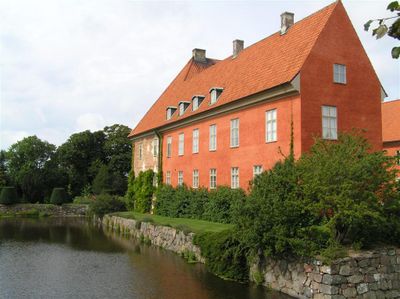
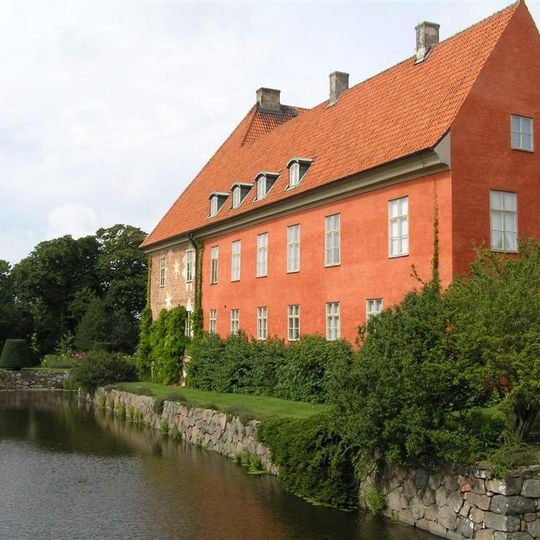
Krapperup is a long, multi-storey building with a pale rendered facade and a steep red-tiled roof, set at the edge of a dark body of water behind a low stone wall and dense shrubs. The roof carries small dormer windows with curved hoods and three tall chimneys, two of brick near the left end and a wider one at the right. The facade has a regular grid of tall, many-paned windows and a slightly projecting bay near the left corner. Its main house is a rectangular brick building in Renaissance style, built in the mid-16th century.
The original castle was built between 1314 and 1353 by Johannes Jonaesson, with a rectangular stone house containing a residence and banquet hall. In the mid-16th century a large rectangular brick main house in Renaissance style was added. Maria Sofia De la Gardie bought the estate in 1667 and rebuilt it in Baroque style; Petter Gotthard von Kochen restored it in Rococo in 1750–60.
The old stable along the road now serves as Kullens konstförening's art gallery, and the former smithy on the inner courtyard holds a castle shop and coffee room. The cattle barn has been converted into a music hall where concerts are held in summer. The estate is listed as a sight by the Michelin guide.
The old stable along the road now serves as Kullens konstförening's art gallery, and the former smithy on the inner courtyard holds a castle shop and coffee room. Summer concerts are held in the converted cow barn, now a music hall. The castle is listed as a sight by the Michelin guide.
A seven-pointed star is carved into the facade, the family crest of the Gyllenstierna, visible since the 1600s. This symbol appears repeatedly throughout the grounds, serving as a personal mark that ties the property to its most influential residents.
The community of curious travelers
AroundUs brings together thousands of curated places, local tips, and hidden gems, enriched daily by 94,512 contributors worldwide.