Turning Torso

Log in to your account

AroundUs is a community-driven map of interesting places, built by curious explorers like you. It grows with every review, story, and photo you share.
Connect to save your favorite spots, contribute locations, and create personalized routes.
By continuing, you accept our Terms and Conditions and our Privacy Policy
Add to collection
Map
Suggest a change
Share

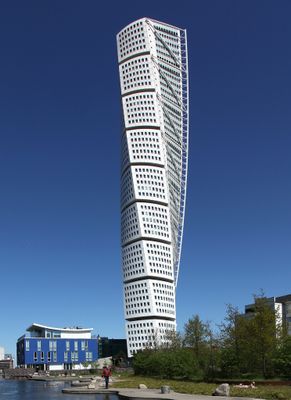
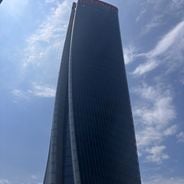
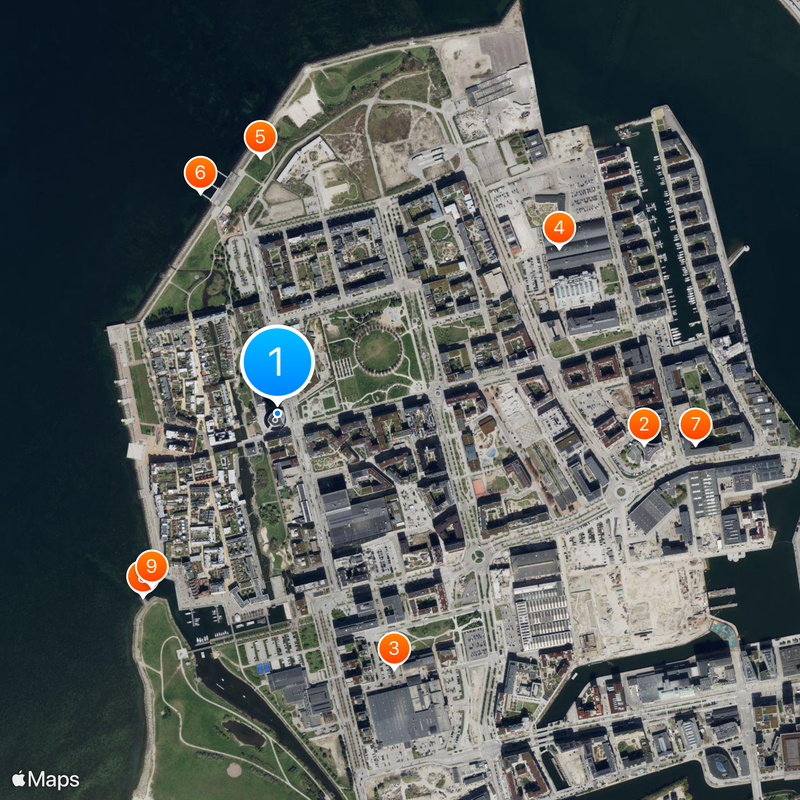
Turning Torso, Residential skyscraper in Västra Hamnen, Malmö, Sweden

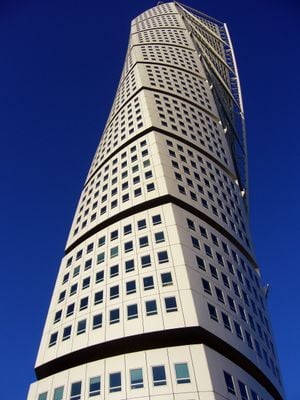
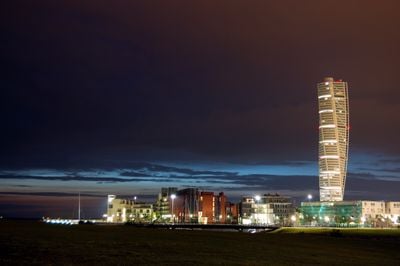
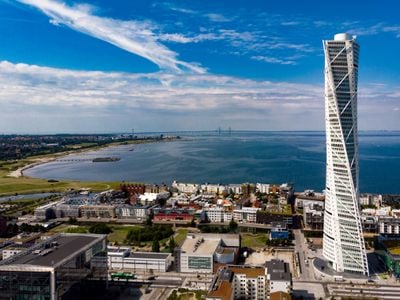
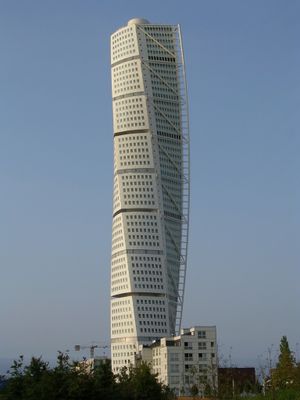
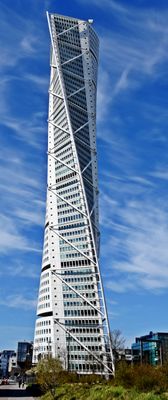
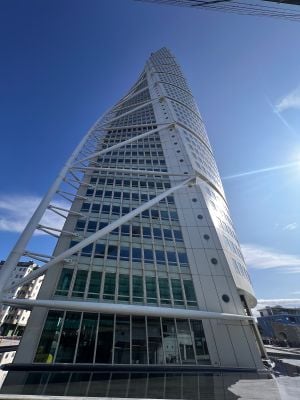
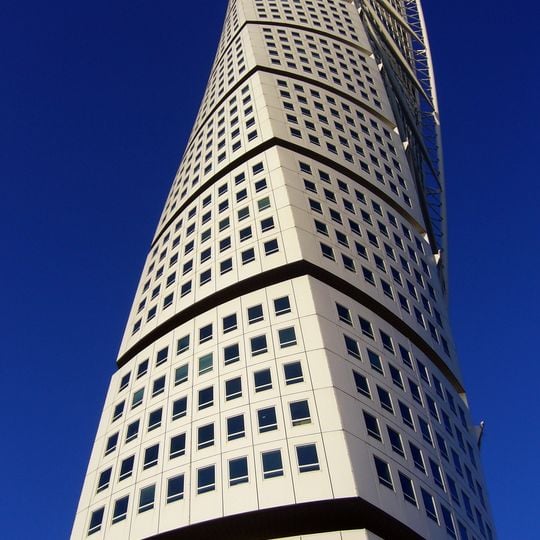
Turning Torso is a residential skyscraper in Västra Hamnen, Malmö, Sweden, made up of nine stacked pentagonal cubes that rotate 90 degrees as they rise. The spiral structure contains 147 apartments across 54 floors and reaches a height of 190 meters.

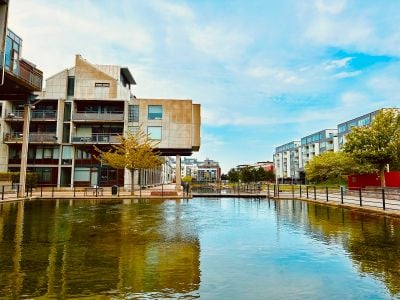
Construction began in 2001 to create a new landmark for Malmö after the removal of the Kockums Crane in 1999. The tower marked the transformation of the former Västra Hamnen dockyard from an industrial zone into a modern residential district.

The name Turning Torso comes from a marble sculpture depicting a twisting human trunk, which served as the model for this spiral residential structure. Today residents live in apartments that open in different directions, each offering different views of the Öresund or the city.

Access to the observation deck on the 49th floor requires advance booking and is available only on selected dates. The building itself is a private residential tower, so public access is limited to these occasional guided visits.

In 2006 Austrian parachutist Felix Baumgartner landed on the narrow roof of this residential structure before jumping from it. This stunt combined a landing on one of Europe's narrowest surfaces with a free fall from 190 meters.

Location: Malmö Municipality

Inception: 2006

Architects: Santiago Calatrava

Official opening: August 27, 2005

Architectural style: postmodern architecture, high-tech architecture

Floors above the ground: 54

Elevators: 5

Height: 190 m

Address: Lilla Varvsgatan

Opening Hours: Monday-Sunday 10:00-20:00

Phone: +4640174500

Website: https://hsb.se/malmo/om-boende/hyreslagenhet/turning-torso--malmos-landmarke

GPS coordinates: 55.61333,12.97639

Latest update: December 4, 2025 23:03

Modern 21st-century architecture: skyscrapers, museums, and landmark buildings

20th and 21st-century architecture has transformed city centers with structures that push engineering boundaries. Observation towers like the Seattle Space Needle and experimental residential complexes like Habitat 67 in Montreal demonstrate the evolution of construction techniques. Architects have explored new forms using materials such as steel, glass, and concrete, creating structures that meet the growing demands of metropolitan areas. This collection includes buildings that marked their time with innovative design. In Barcelona, Antoni Gaudí's Casa Milà features a wavy facade that breaks traditional norms, while in London, 30 St Mary Axe incorporates energy-saving technologies into its 180-meter structure. From Bilbao's Guggenheim Museum clad in titanium to artificial islands shaped in the Persian Gulf in Dubai, these projects illustrate the diversity of architectural approaches worldwide. Each building reflects its urban context while offering solutions to technical and functional challenges of its era.

World's tallest skyscrapers: the map of the tallest towers

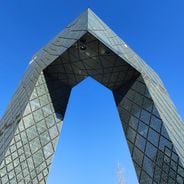
This collection brings together skyscrapers that showcase advances in modern engineering and architecture worldwide. These structures rise above metropolises and reshape city horizons, from the sail-shaped Burj Al Arab in Dubai to the CCTV headquarters in Beijing with its two linked towers. Each building reflects a unique architectural approach and technical innovations tailored to its environment. The selection spans all continents and features buildings with various functions. The Petronas Towers in Kuala Lumpur, 452 meters high and connected by a sky bridge, stand alongside New York’s One World Trade Center, which reaches 541 meters. The Lakhta Center in Saint Petersburg is notable for its twisted glass facade, while the Torre Costanera in Santiago offers panoramic views of the Andes. Whether residential buildings like the Eureka Tower in Melbourne or commercial structures such as the Kingdom Centre in Riyadh, these constructions demonstrate how contemporary architecture shapes 21st-century cities.

The most incredible structures in the world

Architecture does not have to follow straight lines and right angles. This collection presents buildings that stand out through their form: domes, spirals, tilted facades or organic structures that recall animals or plants. From Gaudí's mosaic covered works in Barcelona to the stacked concrete cubes of Habitat 67 in Montreal or the conical trulli of Alberobello, these structures demonstrate alternative approaches to construction. Some emerged from technical necessity, such as the temporary cardboard cathedral in Christchurch after the 2011 earthquake. Others are artistic statements: the Guggenheim Museum in Bilbao with its titanium plates, the Dancing House in Prague or the cubist houses in Rotterdam. In Đà Lạt, the Crazy House transforms tree trunks and caves into habitable spaces, while the Atomium in Brussels represents a magnified iron crystal. These structures attract visitors but also raise questions about function and livability. The Longaberger Basket Building in Ohio takes the form of a seven story basket. The Lotus Temple in New Delhi uses concrete shells to form 27 petals. The Aldar headquarters in Abu Dhabi resembles a circular coin. These buildings expand the definition of what architecture can be.

Exceptional high rise architecture: modern skyscrapers, innovative buildings

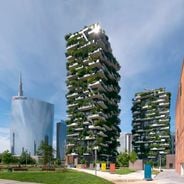
This collection brings together high rises and structures from different continents that redefine conventional building standards through their exceptional architecture. From the spiral rotation of Turning Torso in Malmö to the distinctive form of the CCTV Headquarters in Beijing, these buildings showcase innovative approaches to construction and design. The selection includes Burj Khalifa in Dubai, currently the world's tallest building at 2,717 feet (828 meters), as well as Marina Bay Sands in Singapore with its distinctive rooftop terrace. The collection also presents cultural facilities such as the Guggenheim Museum Bilbao by Frank Gehry with its sculptural titanium facades and the Walt Disney Concert Hall in Los Angeles. Additional examples are the Absolute World Towers in Mississauga, known as the Marilyn Monroe Towers for their twisted structure, as well as Shanghai Tower, which rises 2,073 feet (632 meters). The Guangzhou Opera House and the Helix Bridge in Singapore demonstrate the diversity of contemporary architectural solutions. Each of these structures combines technical innovation with architectural vision and shapes its city's skyline. From historic skyscrapers like the Empire State Building to modern developments like Bosco Verticale in Milan with its planted facades, this selection offers insights into the evolution of high rise construction worldwide.

Twisted architectural towers with innovative rotating designs

Contemporary skyscrapers push the boundaries of vertical architecture with structures that challenge gravity through rotations, twists, and spirals. These buildings reflect advances in structural engineering and allow for residential, commercial, and cultural structures with facades that sometimes rotate 90 degrees from base to top. The Cayan Tower in Dubai stands out with its 1,014-foot height and a full rotation across 73 floors, while the Shanghai Tower reaches 2,073 feet thanks to a twisted shape that reduces wind pressure. These structures can be found worldwide. The Absolute World Towers in Mississauga, Canada, feature wavy designs that earned them the nickname Marilyn Monroe Towers. In Prague, the Dancing House impresses with its curved glass walls contrasting with surrounding historic architecture. The Soumaya Museum in Mexico City displays an asymmetric form covered with thousands of hexagonal aluminum panels. The Lakhta Tower in Saint Petersburg and Capital Gate in Abu Dhabi complete this international selection, illustrating how contemporary architects transform city skylines through engineering feats that combine aesthetics with structural performance.

Historical and Cultural Points of Interest in Malmö

This selection features the historical and cultural sites of Malmö, from the medieval center to public parks. It includes churches, museums, market squares, gardens, and modern buildings that define the city's identity. Visitors discover local architecture, from the Renaissance castle to contemporary structures, as well as the natural and cultural spaces that energize Sweden's third-largest city.

Reviews

Visited this place? Tap the stars to rate it and share your experience / photos with the community! Try now! You can cancel it anytime.

« Turning Torso - Residential skyscraper in Västra Hamnen, Malmö, Sweden » is provided by Around Us (aroundus.com). Images and texts are derived from Wikimedia project under a Creative Commons license. You are allowed to copy, distribute, and modify copies of this page, under the conditions set by the license, as long as this note is clearly visible.

Discover hidden gems everywhere you go!

From secret cafés to breathtaking viewpoints, skip the crowded tourist spots and find places that match your style. Our app makes it easy with voice search, smart filtering, route optimization, and insider tips from travelers worldwide. Download now for the complete mobile experience.

Around Us App Screenshot

A unique approach to discovering new places

Le Figaro

All the places worth exploring

France Info

A tailor-made excursion in just a few clicks

20 Minutes