Biological Museum, Natural history museum in Djurgården, Sweden.
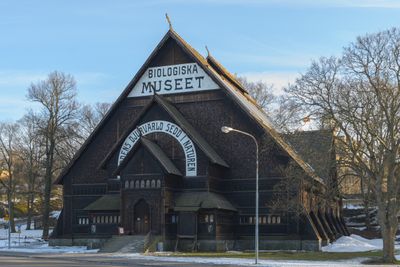
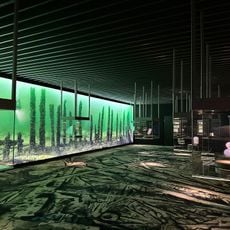
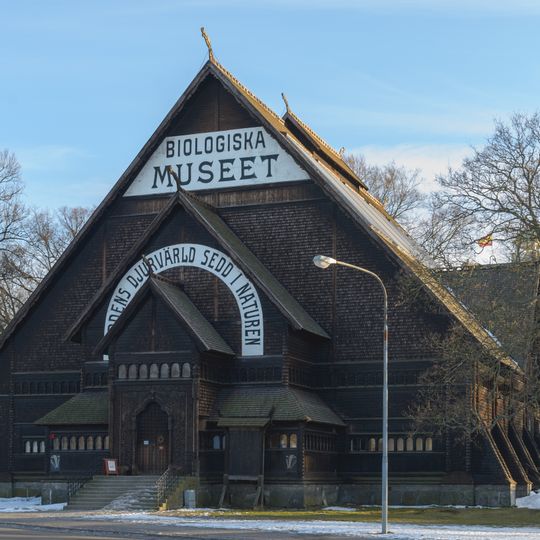
The Biological Museum is a natural history museum in Djurgården, Stockholm, housed in a wooden building with tarred shingles. Its facade, topped by a carved finial, bears a white sign reading "BIOLOGISKA MUSEET" and an arched band with the text "ORENS DJURVÄRLD SEDD I NATUREN". Inside, about 300 stuffed Nordic animals are arranged in dioramas on three floors, with painted backgrounds by Bruno Liljefors and Kjell Kolthoff.
The museum opened in 1893, designed by architect Agi Lindegren, who drew inspiration from medieval Norwegian stave churches for the building's form. The choice was part of a broader interest in the late 1800s in celebrating Nordic identity through architecture and natural science.
The diorama backgrounds on the upper level were painted by Bruno Liljefors, with help from Gustaf Fjæstad; the ground-floor cave and valley scenes were painted by Kjell Kolthoff, son of founder Gustaf Kolthoff. The building's carved portal echoes the Borgund stave church, and the facade originally read "Ensamt i sitt slag – Djurlifs panorama – Utan motsvarighet i verlden".
The building is in Djurgården and can be reached on foot from other nearby attractions on the island. Inside, the lighting shifts with the time of day, which noticeably changes how the dioramas look, so a morning visit tends to offer different conditions than an afternoon one.
The museum is said to be the first to use diorama technique on a large scale to recreate natural environments, a method later adopted by natural history museums in New York and Chicago. Around 300 mounted specimens of Nordic animals are displayed.
The community of curious travelers
AroundUs brings together thousands of curated places, local tips, and hidden gems, enriched daily by 94,705 contributors worldwide.