Herrevad Abbey, Former Cistercian monastery and country house in Ljungbyhed, Klippan Municipality, Sweden
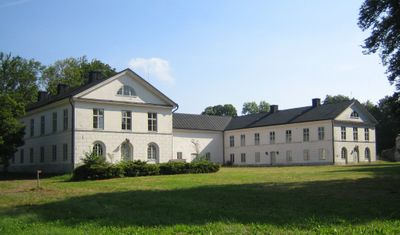
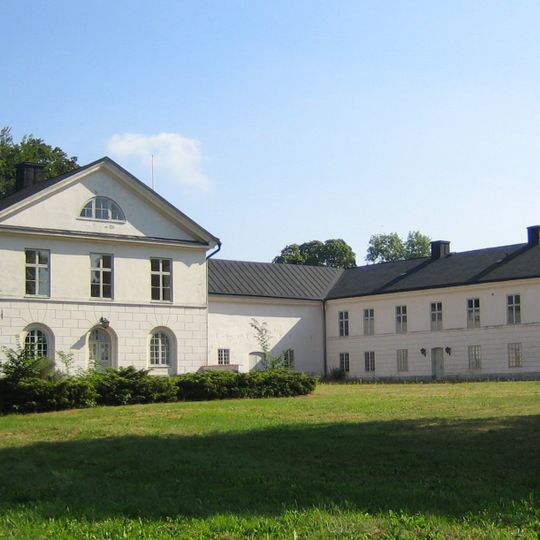
Herrevad Abbey is a former Cistercian monastery near Ljungbyhed, now a country house called Herrevad Castle. The present building, erected in 1817–1818 by A. N. Edelcrantz, is a long two-storey white structure with a dark steep roof: a taller gabled block on the left with a semicircular window in its pediment, three rectangular windows and a ground-level arcade of three arches, and a lower wing to the right with evenly spaced windows and a central door. Almost no medieval superstructure survives; the abbey foundations lie buried, and the church plan was uncovered in excavations in 1939.
The monastery was founded in 1144 as Denmark's first Cistercian establishment and functioned until 1565. It passed to crown ownership during the Protestant Reformation.
The name first meant "army ford" (Herivad), a crossing of the Rönne on the road between Denmark and Sweden; after the abbey was built it became Herrevad, "the Lord's ford", from the toll the abbey charged for the ford and later the bridge. Abbot Laurids, who handed the site to the crown in 1565, died on 30 October 1572; his tombstone is kept in the chapel.
The castle section now functions as residential apartments and is therefore not fully accessible to visitors. It is possible to view the outer structures and walls from outside, especially while walking around the grounds.
Tycho Brahe came to Herrevad, his uncle Sten Bille's estate, and in one of the old monastery buildings Bille fitted out a laboratory for him. There Brahe devised an improvement in paper manufacture and by 1570 was producing paper in Scandinavia for the first time, at the Klippan Mill; a glassworks, the country's first, was also built at his request.
The community of curious travelers
AroundUs brings together thousands of curated places, local tips, and hidden gems, enriched daily by 94,576 contributors worldwide.