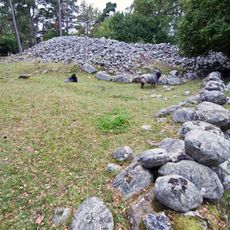
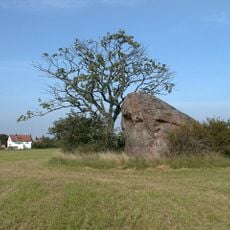
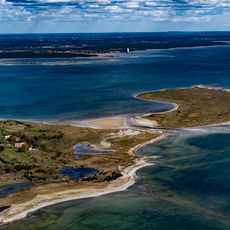
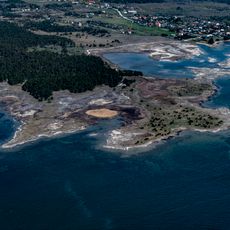
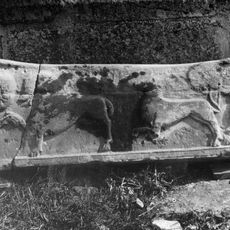
Uggarde rojr, Bronze Age burial cairn in Rone, Gotland, Sweden.
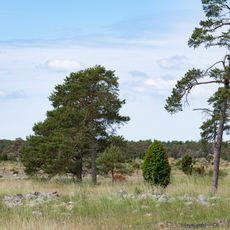
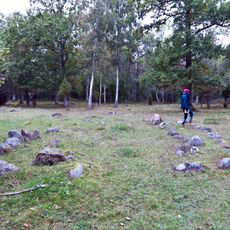
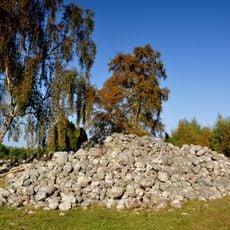
Uggarde rojr is Gotland's largest burial cairn, a rounded mound of fieldstones 7 metres high and 50 metres in diameter, with no crater at its top. Its base is enclosed by a kerb of large stone blocks, and a stone string runs along the road leading to the cairn. It stands on a sparsely vegetated heath in Rone socken, about 200 metres from the ancient shoreline.
Uggarde rojr is dated to the older Bronze Age, 1500–1000 BC, and is Gotland's largest burial cairn at 7 metres high and 50 metres across. It was built about 250 metres from the shoreline of that time; land uplift has since moved it roughly a kilometre inland. The cairn itself has not been excavated, but 2009 digs around it found animal bones, stone flakes and traces of settlement.
The name Uggarde rojr combines the farm name Uggårda with rojr, roir or rör, the Gotlandic words for a stone cairn. The site lies in Rone socken between Rone church and Ronehamn, near the northern shore of Gansviken. The asteroid (10807) Uggarde, discovered in 1993, was named after the site.
The site is open for visitors to explore and nearby seven other large burial cairns in the Rone region can also be visited. Wear sturdy shoes since the terrain can be uneven and muddy depending on the season and recent weather.
The asteroid (10807) Uggarde, discovered in 1993, is named after this cairn. Excavations in the surrounding area in 2009 found animal bones, stone flakes and traces of settlement, although the mound itself has never been investigated.
The community of curious travelers
AroundUs brings together thousands of curated places, local tips, and hidden gems, enriched daily by 94,355 contributors worldwide.