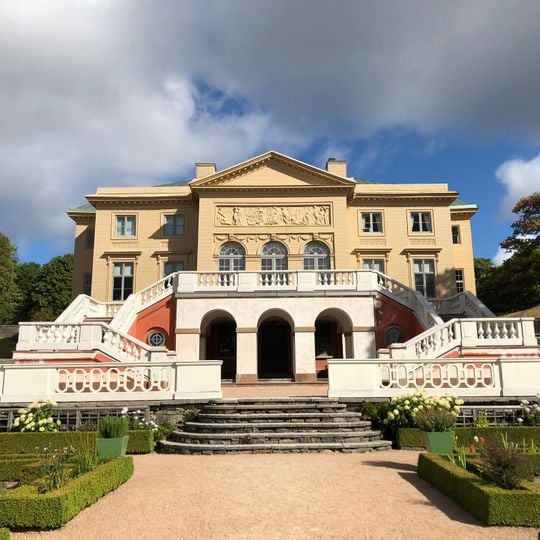
Gunnebo House, Neoclassical manor house in Mölndal, Sweden.
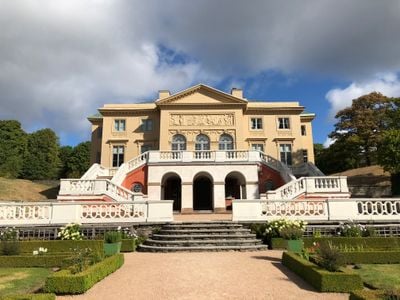
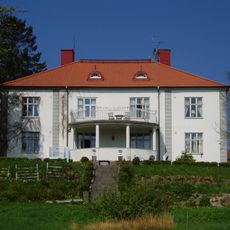
Gunnebo House is a two-storey neoclassical villa of timber clad in smooth horizontal panelling, painted yellow to imitate French sandstone. Its south front has a triangular pediment above a six-metre lead relief cast by Gioacchino Frulli in 1788, showing fishing, hunting, grape harvest and feasting, borne on three round-arched openings. A monumental stone stair with white balustrades descends to the garden.
John Hall, a Gothenburg merchant, began building Gunnebo in 1778 to designs by city architect Carl Wilhelm Carlberg; the house was finished in 1782–1796. After Hall died in 1802 his son John Hall Junior inherited it, but the family's trading business failed during the Napoleonic wars and they sold the estate with all its furnishings. Baroness Hilda Sparre, the last private owner, died in 1948, and Mölndal Municipality bought Gunnebo in 1949.
The name Gunnebo appears in written sources as Gunnobodher in 1397 and comes from the Old Swedish personal name Gunna or Gunne; locals were called Gunneboer in 1659. The house was a summer villa for a non-noble family, and only in 1929 did owner Hilda Sparre begin calling it a slott. Today it is a museum with a shop, restaurant and summer open-air theatre in the gardens.
Visitors can join guided tours offered in several languages and eat at the restaurant that uses produce from the estate's gardens. The grounds are walkable, though paths through the gardens and park have varying levels of ease.
The south facade's six-metre lead relief was cast in 1788 by Gioacchino Frulli and buried during the Swedish-Danish war so the Danes would not seize the lead. It depicts fishing, bathing, livestock, hunting with dogs and muskets, grape harvest and wine-making, ending in a feast.
The community of curious travelers
AroundUs brings together thousands of curated places, local tips, and hidden gems, enriched daily by 93,900 contributors worldwide.