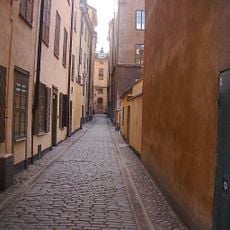
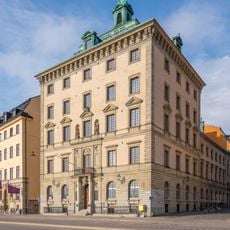
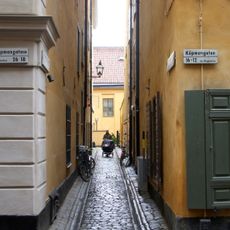
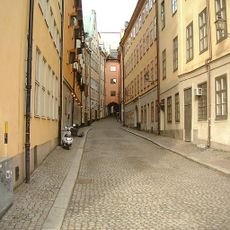
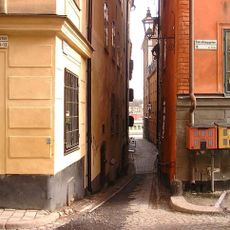
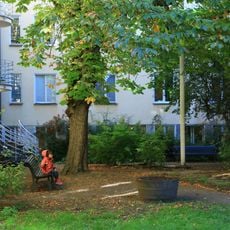
Köpmantorget, Pedestrian square in Gamla stan, Stockholm, Sweden
Köpmantorget is a pedestrian square situated between Köpmangatan and Köpmanbrinken slopes, connecting multiple streets in Stockholm's medieval district. The space is surrounded by shops, restaurants, and cafes that line its edges and draw both locals and visitors throughout the day.
Before 1687 the blocks Pegasus and Perseus were joined by a vault, Köpmanporten, part of Stockholm's older city wall; Elias Brenner drew it shortly before its demolition on 30 April 1687 because of its narrow passage, about 1.6 metres wide. The square laid out after the demolition was still called Köpmanporten in 1728 and appears as Kiöpmanne T on Petrus Tillaeus's 1733 map. It was never a market: medieval trade took place at Fiskartorget.
The name comes from Köpmangatan, the street linking Stortorget to the eastern city gate, not from any market held here; trade took place at Fiskartorget. The square was recorded as Kiöpmanne T. on Petrus Tillaeus's 1733 map and was still called Köpmanporten in 1728. Since 1912 a bronze copy of Bernt Notke's Saint George and the Dragon has stood here, the original being in Storkyrkan.
The square sits where Köpmangatan meets the two slopes of Köpmanbrinken, which descend to Österlånggatan; Bollhusgränd and Baggensgatan leave from its west side. The ground is uneven, with slopes on the eastern approach, so allow time for the climb back up from Österlånggatan. The bronze Saint George stands in the open middle of the square.
The medieval Köpmanporten gate stood here until its demolition on 30 April 1687; Elias Brenner depicted it shortly before, though the real vault was only about 1.6 metres wide, far narrower than his drawing suggests.
The community of curious travelers
AroundUs brings together thousands of curated places, local tips, and hidden gems, enriched daily by 95,285 contributors worldwide.