Baggensgatan, Pedestrian zone in Gamla Stan, Stockholm, Sweden
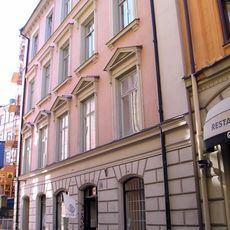
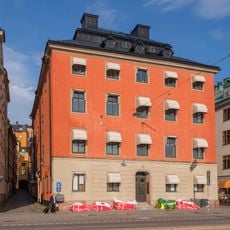
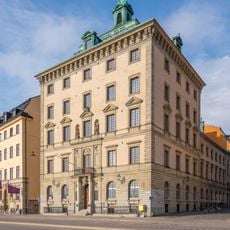
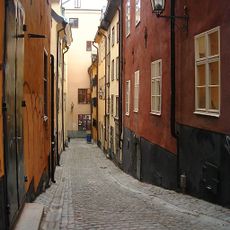
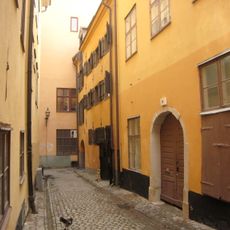
Baggensgatan is a pedestrian zone running south from Bollhusgränd through the medieval heart of Stockholm, lined with historical buildings and narrow cobblestone paths. The street connects multiple landmarks and provides access to shops and cafes while preserving its medieval character through well-maintained architecture.
Baggensgatan, with Bollhusgränd, formed a thoroughfare just inside Stockholm's eastern city wall, as Prästgatan did inside the western wall. It appears in records as Jakob Baggæs gathe in 1596, named after Admiral Jakob Bagge (1502–1577), who was given a lot at number 30 by King Gustav Vasa in 1536. The greatest height difference, almost ten metres, is between Österlånggatan and Baggensgatan. At the southern, lowest end stood the Black Friars' Monastery.
The street is named after Admiral Jakob Bagge, whose family shaped this quarter through property ownership and influence. The narrow lanes and preserved stone facades show how wealthy merchants and nobility once lived in this city core.
The cobblestone surface can be slippery when wet, so proper footwear is important for walking safely. The narrow lanes offer little space for large groups, so visiting early in the day or on quieter days helps you explore the street comfortably.
Number 27 displays the coat of arms of Scottish nobleman Anders Keith and later served as a presbytery for Sigismund of Sweden and Poland. This unusual dual purpose connects secular and religious history at a single address.
The community of curious travelers
AroundUs brings together thousands of curated places, local tips, and hidden gems, enriched daily by 94,191 contributors worldwide.