Fužine Castle, Renaissance castle in Ljubljana, Slovenia
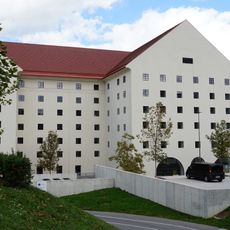
Fužine Castle is a Renaissance castle in Ljubljana with an elongated rectangular floor plan and four corner towers, three square and one round, situated along the Ljubljanica River. The building now contains museum spaces and can be used for events.
Veit Khisl, mayor of Ljubljana, began building the castle in 1528; his son Hans completed it in 1557. The Khisl family, who came from Bavaria in 1519, ran ironworks, mills and a glassworks, and were later ennobled as von Kaltenbrunn. The castle remained largely unchanged until 1897, when a hydroelectric plant was added and the Ljubljanica rapids were destroyed.
The Museum of Architecture and Design has occupied the castle since 1992, displaying collections that trace Slovenian architectural development and feature significant works by architect Jože Plečnik. The exhibitions show how building design evolved in Slovenia over time.
The castle spaces can accommodate events for up to around 800 visitors, and guided tours through the exhibitions are available. Visitors should check beforehand since availability varies depending on scheduled events.
The Fužine hydroelectric power plant, built directly against the castle's south wall, began operating in April 1897 as Slovenia's first alternating-current power station. Its construction destroyed the Ljubljanica rapids that had once driven the castle mill. It was declared a cultural monument in 1984.
The community of curious travelers
AroundUs brings together thousands of curated places, local tips, and hidden gems, enriched daily by 94,082 contributors worldwide.