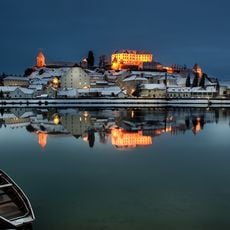
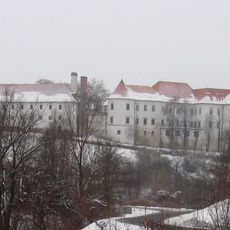
Vurberk Castle, Medieval castle ruins near Maribor, Slovenia.
Vurberk Castle stands on a steep left bank of the Drava in the southern Slovenske gorice hills. Old drawings show a rectangular core with one round defensive tower on live rock, two storeys (22 rooms on the first, 14 on the second), an arcaded courtyard with a cistern and a 72-metre well. A Renaissance wall ring with towers partly survives, along with the lower courtyard and entrance portal restored in 1979.
The castle was first mentioned indirectly in 1238 through its builder Wigand, and directly in 1244 as Wuermwerg. In the 13th century it passed between Salzburg and the Ptuj lords, who rebuilt it after Otokar II of Bohemia reportedly had it destroyed. It stayed with the Stubenbergs until 1616, then the Attems until 1885. On 22 February 1945 bombing badly damaged it and the ruins were later cleared.
The castle's name comes from the German Wurm, meaning worm, which the Hollenburg lords depicted as a legendary dragon on their coat of arms; a dragon appears in the arms of the first known owner, Amelrik of Hollenburg, as early as 1204. Since 1992 the Vurberk Tourist Society has held a festival of folk-entertainment music in the castle courtyard, and it also organises the Štajerska poje choir festival.
Check local access conditions before visiting since the ruins are privately or municipally managed and may have restricted visiting hours. The paths can be uneven and facilities on the grounds are minimal.
The castle courtyard now holds an open-air amphitheatre used for the Vurberk folk music festival, held every year since 1992. The bastion houses the rooms of the local tourist association, which restored the lower courtyard, entrance portal and walls with loopholes in 1979.
The community of curious travelers
AroundUs brings together thousands of curated places, local tips, and hidden gems, enriched daily by 94,658 contributors worldwide.