Haasberg Castle, Baroque mansion ruins in Planina, Slovenia
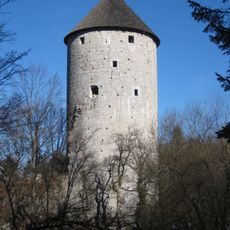
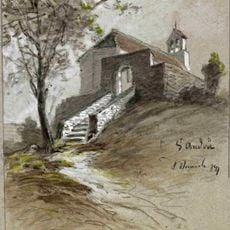
Grad Hošperk, the predecessor of the 17th-century Hošperk mansion, survives as modest ruins on the 703-metre hill Stari grad above Planina. Two sketches by Johannes Clobucciarich from around 1605 show a fortified camp: three small, low, free-standing building masses enclosed by a wide Renaissance perimeter wall, with a small round defensive tower on one side and the opposite tower already collapsed.
The castle was first mentioned in 1295 as castrum Moevntz (Unec Castle). In 1333 the widow of Henry Gralant sold it to the Counts of Gorizia, and in 1435 it passed to the Counts of Celje. After their extinction in 1456 it became a Habsburg fief, and a strong earthquake damaged it in 1511.
The name Haasberg, recorded in 1333 as "Hazperch", is preserved in the Slovene form Hošperk. The castle was held as a fief by the Counts of Gorizia and later the Habsburgs, who leased it to castellans including the Wagen and Rauber families. A 1511 earthquake damaged the castle, and by 1605 drawings by Johannes Clobucciarich show it as a fortified camp with three low, free-standing buildings inside a wide Renaissance wall.
The site is open year-round with no entry fees or advance booking required. The terrain is uneven with loose stones, so wearing sturdy footwear helps when walking through the ruins.
Two sketches from around 1605 by Johannes Clobucciarich show the castle as a fortified camp: three small, low, free-standing buildings inside a wide Renaissance wall, with a round defensive tower on one side and the opposite tower already collapsed. Valvasor also depicted the castle in his Topographia Ducatus Carnioliae modernae.
The community of curious travelers
AroundUs brings together thousands of curated places, local tips, and hidden gems, enriched daily by 94,191 contributors worldwide.